Description
Who is MicroCre²⁰⁰ for?
One ingredient. Five reasons to take it.
Choose your goal and jump to what creatine monohydrate does for you:
Strength & powerMore reps, more load, faster lean-mass gains
Brain & focusMental energy, memory, resistance to fatigue
Healthy ageing 50+Muscle, strength and function as the years add up
Vegetarians & vegansReplace what a plant-based diet leaves out
Why SCN™ MicroCre²⁰⁰
Why this creatine monohydrate, and not any other
Every creatine monohydrate tub on the market claims to be “pure”. Very few tell you the particle size, the source, or what else is in the tub. SCN™ does. MicroCre²⁰⁰ is built on the same philosophy as every SCN™ formula: the most effective form of the ingredient, at the right dose, with nothing added that does not need to be there.
Mesh 200 micronized
Standard creatine monohydrate is roughly mesh 80. Mesh 200 means particles about 2.5× finer, giving a far larger surface area, faster dissolution in water and no gritty residue at the bottom of the shaker. Better solubility means less of the powder is left undissolved and more reaches your muscle.
100% pure, nothing else
No flavourings, no sweeteners, no anti-caking agents, no fillers, no “blend”. The ingredient list is one line long: micronized creatine monohydrate. Mix it into water, juice, your protein shake or your carbohydrate drink; it is tasteless.
Trusted raw-material sourcing
Sourced from established, audited chemical manufacturers to ensure purity, consistency and minimal by-products (creatinine, dicyandiamide and dihydrotriazine), batch after batch.
Honest dose, honest value
Each scoop delivers 3.6 g of creatine monohydrate, above the 3 g daily dose the scientific literature identifies as effective. 40 scoops per tub, and SCN™ multi-buy pricing brings the cost down to a fraction of a coffee per day.
Doping-free & cross-contamination safe
Produced under SCN™ quality controls for competing athletes: no banned substances, no cross-contamination with stimulants or hormones.
Made for endurance, not just the gym
SCN™ is the endurance specialist. This page tells you honestly what creatine monohydrate does for runners, cyclists, triathletes, swimmers and rowers, not just for bodybuilders.
The science
How creatine monohydrate works in your body
Your body stores creatine in muscle, mostly as phosphocreatine. Phosphocreatine is the fastest fuel you have: when a muscle contracts hard, it donates its phosphate to ADP to regenerate ATP, the molecule every cell runs on, in a fraction of a second. The problem is that your natural phosphocreatine stores are small and run down within about 10 seconds of maximal effort. The speed at which you can rebuild ATP is what limits how hard, and how often, you can go.
Supplementing with creatine monohydrate raises muscle creatine and phosphocreatine stores by roughly 20–40% in most people. More phosphocreatine means faster ATP regeneration between efforts, which means more work completed at high intensity, and that extra training stimulus is what builds strength, power and lean mass over the following weeks. The same mechanism works in the brain, which is also an energy-hungry, ATP-dependent organ.
For endurance athletes
Creatine monohydrate for endurance athletes: the race is won in the surges
For years endurance athletes avoided creatine because of the extra body mass. The current evidence says that is a mistake. A 2023 review in the Journal of the International Society of Sports Nutrition concluded that creatine supplementation improves the parts of an endurance race that actually decide it: the attacks, the climbs, the bridge to the breakaway and the sprint finish. Endurance sport is not purely aerobic. Every surge above threshold draws on the ATP–phosphocreatine system, and that is exactly the system creatine monohydrate upgrades.
- Better surges and sprint finishes. Faster phosphocreatine resynthesis lets you repeat high-power efforts within a long race with less fade, whether that is a hill attack on the bike, a pace change at 35 km, or the last 200 m of a swim.
- More glycogen stored. Creatine taken alongside carbohydrate increases muscle glycogen storage compared with carbohydrate alone, meaning a bigger fuel tank before a long event. Pair it with your carbohydrate loading.
- Higher training volume. More quality work in interval and threshold sessions, and faster recovery between them, so you can absorb a bigger weekly load.
- Less muscle damage, faster recovery. Studies in marathon runners and cyclists show reduced markers of muscle damage and inflammation after prolonged exercise when supplementing with creatine.
- Performance in the heat. Creatine increases intracellular water, supporting thermoregulation and reducing the drop in performance when exercising in hot conditions, with lower heart rate and core temperature reported in some studies.
- A sharper brain late in the race. Fatigue is partly central. Creatine supports brain energy supply and has been shown to maintain cognitive performance under sleep deprivation and exhaustive exercise, when pacing decisions matter most.
- Protection during heavy training blocks. Creatine supports lean-mass retention and strength when running volume is high and body mass tends to drop.
- Reduced fatigue in cycling tests. Creatine has reduced fatigue and improved repeated-effort output in laboratory cycling protocols, the model closest to real-world road racing.
Want creatine built specifically for endurance? MicroCre²⁰⁰ is the pure, flexible option you dose yourself. If you prefer a complete endurance formula with three creatine forms, beta-alanine, calcium pyruvate and sports salts in one sachet, see CREndurance Active¹³.
For strength & power
Creatine monohydrate for strength, power and lean muscle
According to the International Society of Sports Nutrition position stand, creatine monohydrate is the most effective nutritional supplement available for increasing high-intensity exercise capacity and lean body mass during training. Decades of trials and meta-analyses agree.
- More strength. Meta-analyses show creatine plus resistance training increases upper- and lower-body strength beyond training alone; typical gains are around 8% greater in maximal strength and 14% greater in reps to failure.
- More power and sprint ability. Improved single and repeated sprint performance, jump height and ballistic power output.
- Faster lean-mass gains. As few as 5–7 days raises lean body weight through cell volumisation; over a training block, users have gained around 2 kg more lean mass than non-users following the same programme.
- Muscle-building signalling. Creatine increases muscle cell water (cell volumisation), supports the production of muscle proteins and IGF-1 and, in some studies, reduces myostatin, the protein that limits muscle growth.
- Works at every level. Unlike many ergogenic aids that only help elite athletes, creatine delivers benefits regardless of training status, sex or age.
- Better recovery between sets and sessions. Faster phosphocreatine recovery means the fifth set looks more like the first.
Stack it: take MicroCre²⁰⁰ with Complete x4 hydrolysed whey isolate post-workout for the full muscle-building signal, or with Bicarb-Lytes¹⁰ Zero before high-intensity sessions to buffer acidity while creatine fuels the output.
For brain & focus
Creatine monohydrate for the brain: energy for thinking
Your brain weighs about 2% of your body but consumes around 20% of your energy, and it uses the same phosphocreatine–ATP system as your muscles. Demanding mental tasks measurably draw down brain phosphocreatine. Supplementing with creatine monohydrate raises brain creatine levels and supports faster ATP regeneration in neurons, along with healthy dopamine signalling and mitochondrial function.
- Memory and processing speed. A systematic review of randomised trials found creatine supplementation improved short-term memory and reasoning, with the clearest effects in people under stress or with low baseline creatine.
- Mental performance under fatigue. Creatine has been shown to preserve cognitive performance, mood and reaction time during sleep deprivation, exactly the state of a shift worker, a student, or an athlete at hour four of a race.
- Less tiredness and mental fatigue. Participants report lower perceived fatigue and higher energy during prolonged demanding tasks.
- Vegetarians see the biggest gains. In vegetarians, who have lower baseline creatine, supplementation improved scores on memory and intelligence tests by 20–50% in a controlled trial.
- Older adults. Two weeks of creatine supplementation significantly improved memory and recall in older individuals.
- Mood support. Emerging research links creatine to brain energy balance and mood regulation, with several trials reporting improvements in mood scores alongside standard care.
For a complete cognitive formula, SCN™ also offers Active¹¹ Brain & Neurosystem; MicroCre²⁰⁰ is the pure creatine foundation to pair it with.
For healthy ageing 50+
Creatine monohydrate after 50: keep the muscle, keep the strength
From our 30s onwards we lose muscle mass and strength every decade, and the rate accelerates after 50 and again after 60. Muscle and strength are what keep you independent, mobile and metabolically healthy. Creatine monohydrate is one of the very few supplements with strong evidence for slowing that decline, and the European Food Safety Authority agrees.
- More lean mass and strength from the same training. A meta-analysis of 22 trials in adults over 55 found creatine plus resistance training produced significantly greater gains in lean tissue, upper-body strength and lower-body strength than training alone.
- Better functional performance. Improvements in sit-to-stand tests, walking speed and balance-related tasks, the movements that determine independence.
- Bone support. Stronger muscles pull harder on bone; several trials in older adults combining creatine with resistance training report favourable effects on bone geometry and strength. Pair it with Liposomal OsteoSure for complete bone nutrition.
- Brain energy and memory. As above: creatine supports memory and recall in older adults, when brain creatine naturally declines.
- Safe for long-term daily use. Trials lasting up to five years in healthy people, including older adults, report no adverse effects on kidney or liver function at recommended doses.
The dose is the same as for athletes: one 3.6 g scoop daily, every day, ideally with a meal. Combine with two or three resistance sessions a week for the full effect.
For vegetarians & vegans
Creatine monohydrate on a plant-based diet
Creatine in food comes almost entirely from meat and fish (about 1–2 g per 500 g of raw meat). Vegetarians and vegans therefore run on their liver’s own production, roughly 1 g per day, and consistently show lower muscle and brain creatine stores. That makes them the group that responds most strongly to supplementation, in muscle performance and in cognition. MicroCre²⁰⁰ is synthetically produced, not animal-derived, and contains no animal ingredients, so it is suitable for vegetarians and vegans.
Monohydrate vs the rest
Why creatine monohydrate is still the gold standard
Creatine HCl, ethyl ester, buffered creatine, nitrate, liquid creatine: new forms arrive every year with claims of superior absorption. The research is clear. Creatine monohydrate is around 99% bioavailable, saturates muscle stores completely, and no alternative form has ever been shown to be more effective in a head-to-head human trial. Many of the alternatives are actually less stable or deliver less creatine per gram. Monohydrate is also the form used in nearly every one of the 500+ studies behind the benefits on this page, and the only form with an EU-authorised health claim.
| Form | Creatine content | Evidence base | Verdict |
|---|---|---|---|
| Creatine monohydrate (micronized) | ~88% | 500+ human studies, EFSA claim | Gold standard, best value |
| Creatine HCl | ~78% | A handful of small studies | More soluble, not more effective |
| Creatine ethyl ester | ~82% | Shown inferior to monohydrate | Degrades to creatinine |
| Buffered creatine | ~88% | No advantage shown vs monohydrate | Marketing, not science |
| Liquid / serum creatine | Variable | Unstable in solution | Avoid |
Micronizing does not change the molecule; it changes the particle size. You keep every benefit of monohydrate and lose the grit and the slow dissolution.
Ingredient breakdown
What is in MicroCre²⁰⁰
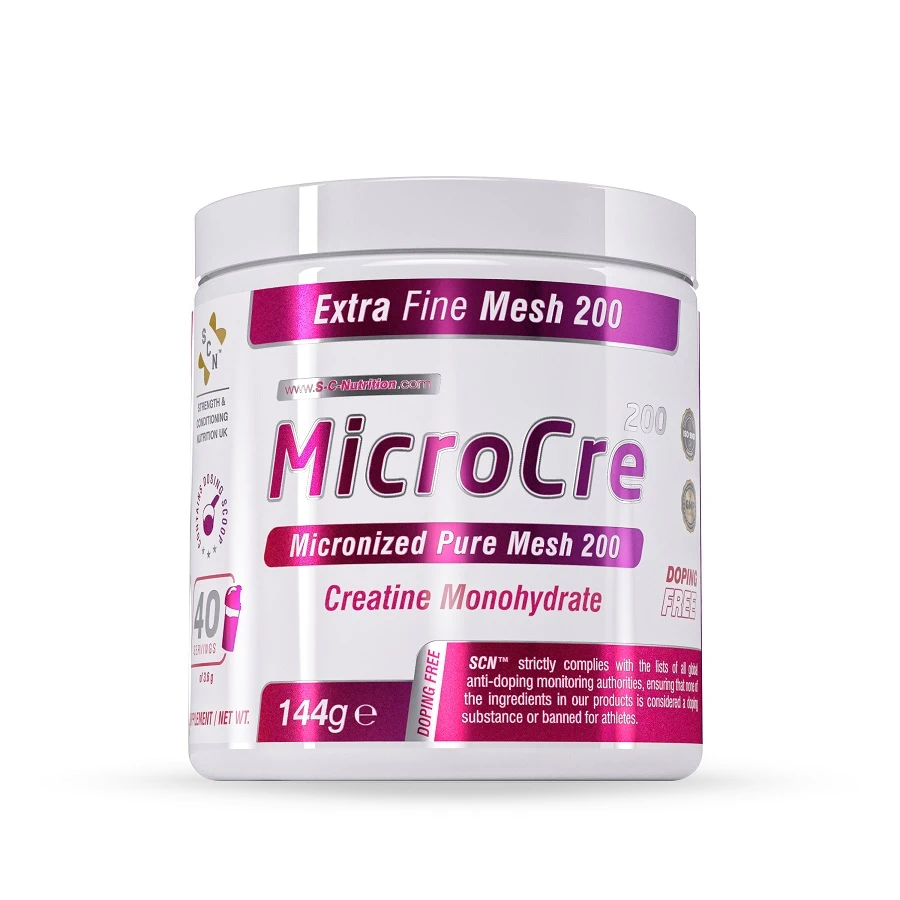
There is exactly one ingredient, written here in full: 100% pure micronized creatine monohydrate, mesh 200. No flavourings, no sweeteners, no colours, no anti-caking agents, no bulking agents, no preservatives.
| Nutritional information | Per scoop (3.6 g) | Per 100 g |
|---|---|---|
| Micronized creatine monohydrate (mesh 200) | 3.6 g | 100 g |
| of which creatine | ≈3.2 g | ≈88 g |
Creatine monohydrate
Creatine (methylguanidinoacetic acid) bound to one molecule of water. It is the stable, crystalline, most studied form of creatine; the water molecule makes up about 12% of the weight, so 3.6 g delivers roughly 3.2 g of active creatine, comfortably above the 3 g EFSA reference dose.
Micronized, mesh 200
The crystals are milled so that they pass through a 200-mesh screen (openings of about 74 microns). Finer particles dissolve faster, stay suspended longer, and reduce the stomach discomfort some people get from coarse creatine settling in the gut.
Product information
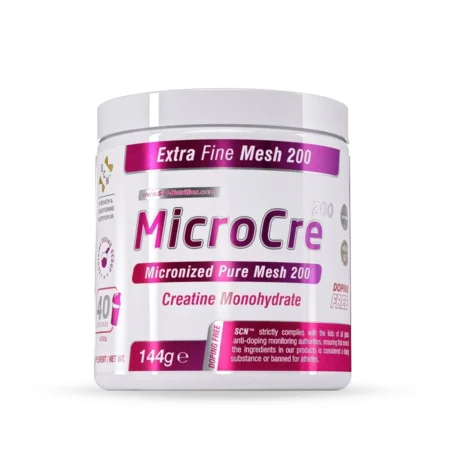
Net weight 144 g · 40 scoops of 3.6 g · no added flavour · neutral taste · suitable for vegetarians and vegans · gluten-free · lactose-free · SKU #SCN_MC200.
How to use
How to take creatine monohydrate for best results
Daily dose (recommended)
Mix one scoop (3.6 g) in 120 ml of water, juice or your shake, once a day, every day. Muscle stores reach saturation in about 3–4 weeks and stay there as long as you keep taking it.
Optional loading
Want results in one week instead of four? Take one scoop four times a day (≈14 g) for 5–7 days, then drop to one scoop daily. Not necessary, just faster. Weight-sensitive endurance athletes should skip loading.
Timing
Consistency matters far more than timing. If you want to optimise, take it after training with carbohydrate and protein, when insulin helps drive creatine into muscle. On rest days, take it with a meal.
Hydration
Creatine draws water into the muscle cell, which is part of how it works. Drink normally, a little more on hot days or during loading.
Do I need to cycle it?
No. Creatine does not down-regulate your own production permanently and there is no evidence that cycling improves results. Long-term daily use is both safe and more effective.
Stacks
Endurance: with Bicarb-Lytes¹⁰ Zero and Pre-Endurance Training Activator. Recovery: with Pro Endurance Recovery. Strength: with Complete x4. Health: with Mag⁵Plex⁷⁵⁰.
Pure creatine monohydrate. Micronized. Nothing added.
40 servings of 100% micronized creatine monohydrate mesh 200. Buy 2 and save 10%, buy 5 get 6, buy 8 get 12.
FAQ
Creatine monohydrate: your questions answered
Is creatine monohydrate safe?
Will creatine make me gain weight or look bloated?
Does creatine cause hair loss?
Is creatine monohydrate good for runners, cyclists and triathletes?
Is creatine good for women?
When is the best time to take creatine?
Do I need to load creatine?
What does “micronized mesh 200” mean?
Is MicroCre²⁰⁰ vegan?
Can I take creatine with caffeine?
MicroCre²⁰⁰ or CREndurance Active¹³?
Evidence
Key scientific references
- Kreider RB et al. International Society of Sports Nutrition position stand: safety and efficacy of creatine supplementation in exercise, sport, and medicine. J Int Soc Sports Nutr. 2017;14:18.
- Forbes SC, Candow DG, Falk Neto JH et al. Creatine supplementation and endurance performance: surges and sprints to win the race. J Int Soc Sports Nutr. 2023;20(1):2204071.
- EFSA Panel on Dietetic Products, Nutrition and Allergies. Scientific Opinion on creatine and increase in physical performance during short-term, high intensity, repeated exercise bouts. EFSA Journal. 2011;9(7):2303. (Authorised under Regulation (EU) No 432/2012.)
- EFSA NDA Panel. Creatine in combination with resistance training and improvement in muscle strength. EFSA Journal. 2016;14(2):4400. (Authorised under Regulation (EU) 2017/672.)
- Branch JD. Effect of creatine supplementation on body composition and performance: a meta-analysis. Int J Sport Nutr Exerc Metab. 2003;13(2):198–226.
- Lanhers C et al. Creatine supplementation and upper limb strength performance: a systematic review and meta-analysis. Sports Med. 2017;47(1):163–173.
- Chilibeck PD et al. Effect of creatine supplementation during resistance training on lean tissue mass and muscular strength in older adults: a meta-analysis. Open Access J Sports Med. 2017;8:213–226.
- Avgerinos KI et al. Effects of creatine supplementation on cognitive function of healthy individuals: a systematic review of randomized controlled trials. Exp Gerontol. 2018;108:166–173.
- Rae C et al. Oral creatine monohydrate supplementation improves brain performance: a double-blind, placebo-controlled, cross-over trial. Proc Biol Sci. 2003;270(1529):2147–2150.
- McMorris T et al. Creatine supplementation, sleep deprivation, cortisol, melatonin and behavior. Physiol Behav. 2007;90(1):21–28.
- Nelson AG et al. Muscle glycogen supercompensation is enhanced by prior creatine supplementation. Med Sci Sports Exerc. 2001;33(7):1096–1100.
- Santos RV et al. The effect of creatine supplementation upon inflammatory and muscle soreness markers after a 30 km race. Life Sci. 2004;75(16):1917–1924.
- Jäger R et al. Analysis of the efficacy, safety, and regulatory status of novel forms of creatine. Amino Acids. 2011;40(5):1369–1383.
- Antonio J et al. Common questions and misconceptions about creatine supplementation: what does the scientific evidence really show? J Int Soc Sports Nutr. 2021;18(1):13.
Use directions: Mix one scoop of powder (3.6 g) in 120 ml of water once daily. Can also be mixed into juice, a protein shake or a carbohydrate drink.
Ingredients: 100% pure micronized creatine monohydrate (mesh 200).
Warnings: Food supplements should not replace a varied and balanced diet and a healthy lifestyle. Do not exceed the stated recommended dose. Keep out of reach of young children. Consult a physician if you are pregnant or lactating, under medical supervision or taking medication. Discontinue use if you experience any allergy. Store in a cool, dry place, lid tightly closed.
This website is for your education and general health information only. The ideas, opinions and suggestions contained on this website are not to be used as a substitute for medical advice, diagnosis or treatment from your doctor for any health condition or problem. Users of this website should not rely on information provided on this website for their own health problems. Any questions regarding your own health should be addressed to your own physician. Please do not start or stop any medications without consulting your doctor.