
描述
Your performance ceiling isn’t your lungs.
It’s your mitochondria.
You can have flawless technique, elite genetics and a training plan built by the best coach in the sport — and still hit the wall early. The real bottleneck isn’t how much oxygen you breathe in. It’s how much of that oxygen your mitochondria can turn into usable energy.
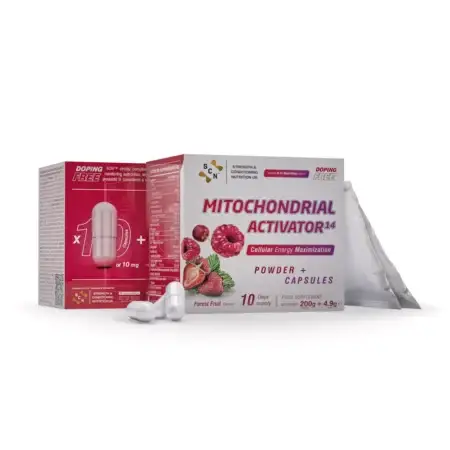
Mitochondrial Activator¹⁴ is the SCN™ mitochondria supplement for athletes: a 14-ingredient formula built around a single idea — give your mitochondria everything they need to build more of themselves, work harder, and keep producing ATP long after untrained cells have given up.
0 caffeine · 0 sugar
600 mg Kaneka™ Ubiquinol
NADH kept separate for potency
100% 無摻雜
Forest Fruit flavour
Which athlete are you?
“My race is decided by how long I can hold threshold.”
Cyclists, runners, triathletes, rowers, swimmers. Your limit is sustained aerobic output — and that is decided inside your mitochondria. This formula feeds the electron transport chain, the fat-oxidation shuttle and the ATP-synthase cofactors that keep your engine running at the top of its range.
“I need to repeat high-intensity efforts, again and again.”
Football, rugby, basketball, CrossFit, hyrox, combat sports. Repeated sprints drain ATP and NAD+ faster than your body replaces them. D-Ribose, NADH and pyruvate are the direct substrates your cells use to recharge between efforts.
“I’m stacking back-to-back sessions and I can’t afford to fade.”
When volume climbs, the raw materials for adaptation — phospholipids, cofactors, NAD+ precursors — become the limiting factor. Mitochondrial Activator¹⁴ supplies them so your training signal turns into new mitochondria, not accumulated fatigue.
What Mitochondrial Activator¹⁴ supports
- Mitochondrial biogenesis — building more cellular power plants
- Mitochondrial density for greater sustained aerobic output
- ATP production for sustained energy output
- Fat oxidation, sparing glycogen for when it matters
- Faster recovery between hard sessions
- Reduced tiredness during heavy training blocks
- Oxygen delivery to working muscles
- Sustained output during endurance efforts
- Mental focus and alertness during long sessions
- Muscle energy status under training stress
- Training capacity across back-to-back sessions
- The electron transport chain that powers every contraction

Why athletes need this formula
Every adaptation you’re chasing — VO2 max, lactate threshold, time to exhaustion, recovery between sessions — comes down to the same cellular event happening billions of times a second inside your muscle: mitochondria converting fuel and oxygen into ATP.
Train hard enough and your body responds by building more mitochondria and making the ones you have work more efficiently. But that adaptation isn’t automatic or unlimited — it depends on your cells having the raw materials available when the signal to adapt goes out: phospholipids to build new mitochondrial membranes, cofactors to run the electron transport chain, substrates to regenerate ATP and NAD+. Train hard without those materials and you cap your own adaptation before it starts.
Mitochondrial Activator¹⁴ was formulated to remove that ceiling — pairing direct energy substrates (D-Ribose, NADH) with the structural and enzymatic support (Ubiquinol, phosphatidylcholine, B-vitamins, magnesium) your mitochondria need to actually use them.
Why Mitochondrial Activator¹⁴ is different
Most “energy” formulas on the market are really just caffeine and sugar. Mitochondrial Activator¹⁴ contains neither. Instead, it’s built entirely around mitochondrial physiology — direct NAD+ and ATP precursors, the electron transport chain’s own coenzyme (Ubiquinol CoQ10), the fatty-acid shuttle that feeds mitochondria (L-carnitine), and the phospholipid building blocks needed to construct new mitochondrial membrane.
Two sachets + one capsule. On purpose.
We split the formula deliberately: 20 g across two sachets for the full mitochondrial support matrix, plus a separate NADH capsule. NADH is notoriously unstable once dissolved in liquid — keeping it encapsulated and dry preserves its potency until the moment you take it. It is the reason this is the mitochondria supplement for athletes who want the NADH they paid for to still be NADH when it reaches their cells.
Who it’s for: Endurance athletes, hybrid athletes, and anyone whose sport is decided by how long they can sustain high aerobic output — cycling, running, triathlon, rowing, team-sport athletes with repeated high-intensity demands, and anyone in a heavy training block who needs their cellular energy system to keep pace with training load.
100% Doping Free. No Exceptions.
SCN™ strictly complies with the lists of all global anti-doping monitoring authorities, ensuring that none of the ingredients in our products is considered a doping substance or banned for athletes.
Why mitochondrial function is the real performance ceiling
Mitochondria are often called the “powerhouses of the cell,” and for athletes that’s not a throwaway line — it’s the entire game. Every muscle contraction is paid for in ATP, and the vast majority of that ATP, especially during sustained aerobic effort, comes from oxidative phosphorylation happening inside your mitochondria. The better your mitochondria are at this job — how many you have, and how efficiently each one runs — the higher your ceiling for endurance performance.
This is why elite endurance athletes don’t just have bigger hearts and lungs; at the cellular level, their muscle fibres are packed with a larger, denser, more efficient population of mitochondria than untrained tissue. Two specific concepts explain why, and both are directly relevant to what Mitochondrial Activator¹⁴ is designed to support: mitochondrial biogenesis 和 mitochondrial density.
What is mitochondrial biogenesis?
Mitochondrial biogenesis is the process by which your cells build brand-new mitochondria — literally growing more cellular power plants in response to training stress. It’s driven by a master regulatory pathway centred on a protein called PGC-1α, which gets switched on by endurance training stimuli and by specific nutritional signals, including the cell’s available NAD+ supply and certain plant compounds shown to activate this pathway.
This matters because biogenesis is the mechanism behind one of the most valuable adaptations in endurance sport: without it, you can train for years and still be capped by the same number of mitochondria you started with.
How Mitochondrial Activator¹⁴ links to biogenesis: NADH and the formula’s Vitamin B3 complex both feed directly into your cell’s NAD+ pool — the same pool that governs the sirtuin enzymes (SIRT1, SIRT3) sitting upstream of PGC-1α activation. Quercetin, from the Sophora japonica extract in this formula, has been studied specifically for its role in activating the AMPK/SIRT1/PGC-1α signalling pathway. And once the signal to build new mitochondria is switched on, phosphatidylcholine (from the soy lecithin in this formula) supplies the phospholipid raw material your cells actually use to construct the new mitochondrial membranes.
What is mitochondrial density?
Mitochondrial density is simply how many mitochondria you have packed into each unit of muscle tissue. It’s one of the clearest physiological differences between trained and untrained muscle, and it’s a major reason elite endurance athletes can sustain a higher percentage of their VO2 max for longer: more mitochondria means more total capacity for oxidative ATP production running in parallel, at any given moment, in every fibre doing the work.
Higher density also means a greater capacity to burn fat as fuel — since fat oxidation happens inside the mitochondria, more of them means more surface area for that process to occur, sparing glycogen for when you really need it.
How Mitochondrial Activator¹⁴ links to density: building a denser mitochondrial network is only useful if you can also fuel and run it. L-carnitine tartrate is the shuttle that transports fatty acids across the mitochondrial membrane for oxidation — the more mitochondria you have, the more shuttling capacity you need, and this formula supplies it directly. Ubiquinol (CoQ10) is a core, non-negotiable component of the electron transport chain inside every single mitochondrion, so a denser network needs a correspondingly larger CoQ10 supply to keep every unit running at capacity. And magnesium is a required cofactor for ATP synthase — the enzyme that physically produces ATP in each mitochondrion — meaning more mitochondria simply means more magnesium-dependent ATP synthase complexes that need to be kept supplied.

建議每日劑量的營養素
上菜: 2 sachets (20 g) + 1 NADH capsule
建議用途: Mix two sachets with 200 ml of room-temperature water. Consume together with 1 NADH capsule, 40 minutes before training.
淨重: 200 g (sachets) + 4.9 g (capsules) = 204.9 g total · 20 sachets + 10 capsules · Forest Fruit flavour
| 成分 | Per 2 sachets (20 g) |
|---|---|
| D-核糖 | 4 g |
| Soy Lecithin (providing Phosphatidylcholine 480 mg) | 1.6 g |
| MTA¹⁴ Calcium Complex (Calcium pyruvate + Dicalcium phosphate — Calcium 892 mg, 111.5% NRV) | 2 g |
| L-Ornithine Alpha-Ketoglutarate | 1000 毫克 |
| 酒石酸左旋肉鹼 | 1000 毫克 |
| Magnesium Malate (Magnesium 230 mg, 61% NRV) | 1000 毫克 |
| Kaneka™ Ubiquinol | 600 毫克 |
| 肌醇 | 500 毫克 |
| MTA¹⁴ Vitamin B3 Complex (Total Niacin 400 mg NE, 2250% NRV) | 400 mg NE |
| Sophora japonica Extract (providing 槲皮素 123.5 mg) | 130 mg |
| Cocarboxylase — Vitamin B1 | 40 mg (3636% NRV) |
| Bioperine® Black Pepper Extract (providing Piperine 19 mg) | 20毫克 |
| Pyridoxal-5-Phosphate — Vitamin B6 | 10 mg (571% NRV) |
| 輔酶A (Nicotinamide adenine dinucleotide) | 10 mg — per 1 capsule |
Calcium, magnesium, niacin and vitamins B1 and B6 contribute to normal energy-yielding metabolism.
The formula, written out in full
Fourteen actives. No proprietary blend hiding the doses, nothing hidden behind a “see more”. Every ingredient, what it does, and what the research says.
1D-Ribose — 4 g
“The molecular backbone of your energy currency.”
它是什麼: D-Ribose is the naturally occurring five-carbon sugar your cells use to build the backbone of ATP, NAD+, and every other energy-carrying molecule your mitochondria depend on. Without ribose, there’s no molecule to charge with energy in the first place.
How it helps an athlete: Hard training depletes your cellular ATP and NAD+ pools faster than your body can casually replace them. Supplying ribose directly gives your mitochondria the raw building block they need to resynthesize these molecules quickly, instead of relying solely on slower metabolic pathways to make it from scratch.
Sport benefits
- Supports faster ATP resynthesis after intense training
- Provides raw material for NAD+ regeneration, central to mitochondrial energy production
- Supports recovery of cellular energy stores between hard sessions
- May help reduce the accumulated fatigue of high-volume training blocks
- Supports sustained energy availability during prolonged endurance efforts
- Complements NADH by supplying the backbone the mitochondria build upon
- Supports muscle energy charge during repeated high-intensity efforts
- Helps maintain training quality across consecutive hard sessions
Health benefits
- Supports normal cellular energy metabolism
- May support heart muscle energy status under physical strain
- Contributes to the body’s natural nucleotide synthesis pathways
- Supports general vitality during periods of high physical demand
2Soy Lecithin (Phosphatidylcholine 480 mg) — 1.6 g
“The building material for new mitochondria.”
它是什麼: Soy lecithin is rich in phosphatidylcholine, a phospholipid that forms a major structural component of every cell membrane in your body — including the inner and outer membranes of your mitochondria.
How it helps an athlete: When your body responds to training by triggering mitochondrial biogenesis, it needs phospholipid material to physically build the membranes of each new mitochondrion. Phosphatidylcholine supplies exactly that — supporting the structural side of an adaptation that’s often discussed only in terms of signalling.
Sport benefits
- Supplies structural phospholipids for new mitochondrial membrane formation
- Supports mitochondrial membrane integrity under training stress
- Complements the formula’s biogenesis-linked ingredients (NADH, Quercetin)
- Supports cell membrane fluidity important for nutrient transport
- May support recovery of muscle cell membranes after intense training
- Supports the structural side of long-term training adaptation
- Contributes to normal fat transport and utilisation
- Supports overall cellular resilience during high training loads
Health benefits
- Supports normal liver fat metabolism
- Contributes to healthy cell membrane structure throughout the body
- Supports normal cognitive function via membrane-dependent neurotransmission
- Supports normal cholesterol transport and metabolism
3MTA¹⁴ Calcium Complex (Calcium Pyruvate & Dicalcium Phosphate) — 2 g
“The spark that switches the Krebs cycle on.”
它是什麼: This complex combines calcium pyruvate and dicalcium phosphate — delivering both elemental calcium (892 mg, 111.5% NRV) and pyruvate, the direct substrate that enters the mitochondria to fuel the Krebs cycle.
How it helps an athlete: Calcium isn’t just for bones and muscle contraction — inside the mitochondria, calcium activates several of the key enzymes that drive the Krebs cycle forward, directly increasing the rate at which ATP can be produced. Pyruvate, meanwhile, is the fuel those enzymes are waiting to process.
Sport benefits
- Calcium activates key Krebs cycle dehydrogenase enzymes, supporting ATP output
- Pyruvate provides a direct substrate for mitochondrial energy production
- Supports efficient conversion of carbohydrate fuel into usable energy
- Calcium plays a role in muscle contraction and excitation-coupling
- Supports sustained power output during repeated efforts
- Contributes to normal energy-yielding metabolism (calcium, EU-authorised claim)
- May support metabolic efficiency during endurance exercise
- Supports nerve-to-muscle signal transmission during training
Health benefits
- Contributes to normal energy-yielding metabolism
- Supports normal muscle function
- Contributes to normal bone and teeth maintenance
- Supports the process of cell division and specialisation
4L-Ornithine Alpha-Ketoglutarate (OKG) — 1000 mg
“Clears the exhaust, refuels the engine.”
它是什麼: OKG combines ornithine, which supports the body’s natural ammonia-clearing pathways, with alpha-ketoglutarate — itself a direct Krebs cycle intermediate that can be used to refuel mitochondrial energy production.
How it helps an athlete: Intense training generates ammonia as a metabolic by-product, and elevated ammonia can interfere with efficient cellular energy production. OKG supports the clearance side of that equation while simultaneously topping up a Krebs cycle intermediate your mitochondria can put straight to work.
Sport benefits
- Supports the body’s natural ammonia-clearing processes during intense exercise
- Provides a direct Krebs cycle intermediate to support mitochondrial ATP output
- May support reduced perceived fatigue during prolonged training
- Supports nitrogen balance during high training volumes
- Complements calcium pyruvate in feeding the Krebs cycle
- Supports training capacity during consecutive high-intensity sessions
- May support post-exercise recovery processes
- Supports maintenance of lean muscle tissue during heavy training blocks
Health benefits
- Supports normal protein metabolism
- Contributes to the body’s natural detoxification processes
- Supports normal immune system function during periods of physical stress
- May support gut and digestive comfort during intense training
5L-Carnitine Tartrate — 1000 mg
“The shuttle that feeds every mitochondrion you have.”
它是什麼: L-carnitine is the molecule responsible for transporting long-chain fatty acids across the mitochondrial membrane, where they can be broken down for energy through beta-oxidation. No carnitine, no fat gets in.
How it helps an athlete: The more mitochondria you build through training, the more fatty-acid shuttling capacity you need to keep them all supplied. Carnitine is the rate-limiting step in that supply chain — supporting your ability to use fat as a sustainable fuel source and spare glycogen for when it matters most.
Sport benefits
- Transports fatty acids into the mitochondria for energy production
- Supports fat oxidation capacity, sparing glycogen during long efforts
- Supports endurance capacity during steady-state, fat-fuelled training
- May support reduced muscle damage markers after intense exercise
- Supports recovery between training sessions
- Complements a denser mitochondrial network by supplying the fuel it needs
- Supports sustained energy availability in long-duration events
- May support exercise capacity during multi-hour training blocks
Health benefits
- Supports normal fat metabolism
- Contributes to normal cardiovascular function
- Supports healthy energy levels during periods of high physical demand
- May support healthy ageing of muscle tissue

6Magnesium Malate — 1000 mg (Magnesium 230 mg, 61% NRV)
“The cofactor every ATP molecule needs to work.”
它是什麼: Magnesium is required for the enzyme ATP synthase to physically produce ATP inside your mitochondria — in fact, ATP itself is only biologically active when bound to magnesium (as Mg-ATP). Malate, its pairing here, is itself a Krebs cycle intermediate.
How it helps an athlete: More mitochondria and a faster Krebs cycle both mean more magnesium-dependent enzyme activity happening simultaneously. This formula supplies both the mineral and a usable organic acid to support that load directly.
Sport benefits
- Required cofactor for ATP synthase, the enzyme that produces ATP
- Malate supports Krebs cycle activity and the malate-aspartate shuttle
- Contributes to normal energy-yielding metabolism (EU-authorised claim)
- Supports normal muscle contraction and relaxation
- May support reduced cramping during prolonged exercise
- Supports electrolyte balance during heavy sweat losses
- Contributes to normal protein synthesis supporting training adaptation
- Supports normal psychological function under training stress
Health benefits
- Contributes to normal energy-yielding metabolism
- Supports normal muscle function and the reduction of tiredness and fatigue
- Contributes to normal functioning of the nervous system
- Supports normal bone maintenance
7Kaneka™ Ubiquinol — 600 mg
“The coenzyme sitting inside every electron transport chain you own.”
它是什麼: Ubiquinol is the active, reduced form of Coenzyme Q10 — a core component of the electron transport chain, the final and most productive stage of mitochondrial ATP production. Unlike standard CoQ10 (ubiquinone), ubiquinol is already in the form your body can use directly.
How it helps an athlete: Every mitochondrion you have — and every new one you build — needs its own working supply of CoQ10 to move electrons through the chain and generate ATP. A denser mitochondrial network needs proportionally more of it, and the reduced ubiquinol form supports that without requiring your body to do the conversion first.
Sport benefits
- Core component of the electron transport chain, central to ATP production
- Supports energy output across a denser mitochondrial network
- Antioxidant properties help protect mitochondrial membranes from training-induced oxidative stress
- Supports endurance performance during sustained aerobic effort
- May support reduced muscular fatigue during prolonged training
- Supports training capacity during heavy competition phases
- Complements magnesium and B-vitamins in the energy-production pathway
- Supports recovery of energy status after intense sessions
Health benefits
- Supports normal cardiovascular function
- Provides antioxidant protection against oxidative stress
- Supports healthy cellular ageing
- Contributes to general vitality and wellbeing
8Inositol — 500 mg
“The signal behind the signal.”
它是什麼: Inositol is a naturally occurring compound involved in building phosphatidylinositol, a signalling phospholipid your cells use to relay messages — including calcium-based signals relevant to mitochondrial activity.
How it helps an athlete: Cellular signalling is what turns a training stimulus into an adaptation. Inositol supports the messaging infrastructure your cells use to coordinate that response.
Sport benefits
- Supports cell signalling pathways involved in the training response
- Contributes to calcium-based signalling relevant to muscle and mitochondrial function
- Supports normal fat metabolism alongside the formula’s carnitine content
- May support mental focus during demanding training blocks
- Supports normal nervous system signalling during exercise
- Complements the formula’s phospholipid-supporting ingredients
- Supports overall cellular communication under training stress
- May support a balanced response to physical and mental training demands
Health benefits
- Supports normal nervous system function
- Contributes to normal cell membrane signalling
- Supports psychological wellbeing during periods of high stress
- May support healthy mood balance
9MTA¹⁴ Vitamin B3 Complex (Niacin) — 400 mg NE
“The direct precursor to your mitochondria’s electron carrier.”
它是什麼: This complex delivers niacin in two forms — nicotinamide and nicotinic acid — both of which your body uses to build NAD+, the single most important electron carrier in mitochondrial oxidative phosphorylation.
How it helps an athlete: NAD+ availability doesn’t just power the electron transport chain directly — the NAD+/NADH ratio also governs sirtuin activity, the enzymes that sit upstream of the PGC-1α pathway responsible for mitochondrial biogenesis. Keeping this pool well supplied supports both immediate energy output and the longer-term adaptation of building more mitochondria.
Sport benefits
- Direct precursor to NAD+, essential for mitochondrial ATP production
- Supports the sirtuin/PGC-1α signalling pathway linked to mitochondrial biogenesis
- Contributes to normal energy-yielding metabolism (EU-authorised claim)
- Supports sustained energy output during prolonged training
- May support reduced tiredness during heavy training blocks
- Complements NADH in supporting the cellular NAD+ pool
- Supports normal function of the nervous system during exercise
- Supports psychological performance under competitive stress
Health benefits
- Contributes to normal energy-yielding metabolism
- Supports normal functioning of the nervous system
- 有助於減少疲勞和倦意
- Supports normal skin and mucous membrane health
10Sophora Japonica Extract (Quercetin 123.5 mg) — 130 mg
“The plant compound studied for switching biogenesis on.”
它是什麼: This extract provides a concentrated dose of quercetin, a flavonoid found in various plants and studied specifically for its ability to activate the AMPK/SIRT1 signalling pathway that sits directly upstream of PGC-1α — the master regulator of mitochondrial biogenesis.
How it helps an athlete: Where niacin and NADH supply the fuel for this pathway, quercetin has been researched for its potential to help switch it on — supporting the biological signal that tells your cells it’s time to build more mitochondria.
Sport benefits
- Studied for activating signalling pathways linked to mitochondrial biogenesis
- Antioxidant properties support cellular resilience during intense training
- Supports normal immune function during heavy training cycles
- May support reduced exercise-induced inflammation
- Supports cardiovascular function during endurance training
- Complements the formula’s NAD+-supporting ingredients
- Supports training capacity during sustained high-volume blocks
- May support recovery between demanding sessions
Health benefits
- Provides antioxidant support against oxidative stress
- Supports normal immune system function
- Contributes to normal cardiovascular health
- Supports the body’s natural anti-inflammatory processes
11Cocarboxylase (Vitamin B1 — Thiamine Pyrophosphate) — 40 mg
“The gatekeeper between your fuel and your Krebs cycle.”
它是什麼: Cocarboxylase is the active coenzyme form of vitamin B1, required by pyruvate dehydrogenase — the enzyme that acts as the gateway connecting glycolysis to the Krebs cycle inside the mitochondria.
How it helps an athlete: Without enough active B1, pyruvate can’t efficiently enter the mitochondria to be converted into usable energy, no matter how much carbohydrate fuel is available. This active, “ready-to-use” form supports that conversion directly.
Sport benefits
- Required cofactor for converting carbohydrate fuel into mitochondrial energy
- Supports the gateway step between glycolysis and the Krebs cycle
- Contributes to normal energy-yielding metabolism (EU-authorised claim)
- Supports normal nervous system function during high-intensity training
- May support reduced fatigue during carbohydrate-dependent efforts
- Supports psychological performance under competitive pressure
- Complements the formula’s other Krebs cycle-supporting ingredients
- Supports normal heart function during sustained exertion
Health benefits
- Contributes to normal energy-yielding metabolism
- Supports normal functioning of the nervous system
- Supports normal psychological function
- Contributes to normal heart function
READ MORE HERE → THIAMINE PYROPHOSPHATE

12Bioperine® Black Pepper Extract (Piperine 19 mg) — 20 mg
“Makes sure the rest of the formula actually gets used.”
它是什麼: Bioperine® is a standardised black pepper extract providing piperine, one of the most well-studied natural compounds for enhancing the absorption of other nutrients.
How it helps an athlete: A formula is only as good as what your body actually absorbs. Piperine supports the bioavailability of the vitamins, minerals and plant compounds throughout this formula, helping ensure the mitochondrial-support ingredients above actually reach your cells in meaningful amounts.
Sport benefits
- Supports enhanced absorption of the formula’s vitamins and minerals
- Supports bioavailability of Ubiquinol and Quercetin specifically
- Helps ensure consistent nutrient delivery across training blocks
- Supports overall formula efficiency at the stated doses
- May support digestive comfort around training
- Complements every other ingredient in the formula
- Supports consistent day-to-day nutrient uptake
- Supports the value of the full 14-ingredient matrix
Health benefits
- Supports normal digestive function
- Contributes to nutrient bioavailability generally
- Supports antioxidant activity alongside quercetin
- May support normal metabolic function
13Pyridoxal-5-Phosphate (Vitamin B6, active form) — 10 mg
“Ready to work the moment it’s absorbed.”
它是什麼: Pyridoxal-5-Phosphate (P-5-P) is the bioactive, “coenzymated” form of vitamin B6 — meaning it doesn’t require conversion by the liver before your body can use it, unlike standard B6 supplements.
How it helps an athlete: B6 is essential for amino acid metabolism, for breaking down stored glycogen into usable glucose, and for the synthesis of haemoglobin that carries oxygen to your muscles and mitochondria in the first place.
Sport benefits
- Supports glycogen breakdown into usable glucose for mitochondrial fuel
- Essential for haemoglobin synthesis, supporting oxygen delivery to muscle
- Contributes to normal energy-yielding metabolism (EU-authorised claim)
- Supports amino acid metabolism for muscle repair
- May support reduced muscle cramping
- Supports normal psychological function during competition
- Supports normal nervous system function under training stress
- Immediately bioavailable, requiring no additional conversion step
Health benefits
- Contributes to normal energy-yielding metabolism
- Supports normal red blood cell formation
- Contributes to normal functioning of the nervous system
- Supports normal psychological function
14NADH — 10 mg per capsule (separate capsule)
“The direct fuel for Complex I — where oxidative energy production begins.”
它是什麼: NADH is the reduced, biologically active form of NAD+ — the same molecule niacin is used to build, but here delivered ready-to-use. NADH donates electrons directly to Complex I of the electron transport chain, the very first step of oxidative phosphorylation. It’s delivered in its own capsule, separate from the sachets, because NADH is notably unstable once dissolved — keeping it dry and encapsulated protects its potency until you take it.
How it helps an athlete: Where niacin supports your body’s own NAD+ production over time, NADH supplies the active molecule directly — supporting immediate electron transport chain activity as well as the NAD+/NADH balance that governs sirtuin signalling and, in turn, mitochondrial biogenesis.
Sport benefits
- Directly feeds Complex I of the electron transport chain
- Supports immediate mitochondrial ATP production
- Supports the NAD+/NADH balance linked to biogenesis signalling
- May support reduced perceived fatigue during training
- Supports sustained aerobic output during endurance efforts
- Complements niacin’s role in NAD+ metabolism
- Supports mental alertness and focus during long sessions
- Delivered in a stable, encapsulated form to preserve potency
Health benefits
- Supports normal cellular energy production
- May support mental clarity and focus
- Contributes to the body’s natural antioxidant defence systems
- Supports overall vitality during periods of high physical demand
READ MORE HERE → NADH – CELLULAR ENERGY PRODUCTION
How to use Mitochondrial Activator¹⁴
上菜: 2 sachets (20 g) + 1 NADH capsule, daily · 每個容器的份量: 10 · 淨重: 200 g (sachets) + 4.9 g (capsules) — 204.9 g total · 風味: Forest Fruit
Suggested use based on your sport needs
- Normal and high-intensity sessions under 90 minutes → choose the 10 NADH capsules option.
Mix 2 sachets (20 g) with 200 ml of room-temperature water. Drink together with 1 NADH capsule, 40 minutes before training or physical activity. - Normal-intensity sessions over 90 minutes → choose the 20 NADH capsules option.
Mix 1 sachet (10 g) with 100 ml of room-temperature water. Drink together with 1 NADH capsule, 40 minutes before training. Repeat (10 g / 100 ml + 1 NADH capsule) 10 minutes after you start training. - High-intensity sessions over 90 minutes → choose the 40 NADH capsules option.
Mix 1 sachet (10 g) with 100 ml of room-temperature water. Drink together with 2 NADH capsules, 40 minutes before training. Repeat (10 g / 100 ml + 2 NADH capsules) 10 minutes after you start training.
成份
Sachets: D-Ribose, Stabiliser (Jelucel PF30 – Cellulose powder), Maltodextrin, Bulking agent (polydextrose), Soy lecithin powder (30% phosphatidylcholine), Calcium pyruvate, L-ornithine alpha-ketoglutarate, L-carnitine tartrate, Magnesium malate, Forest fruit flavouring, Kaneka™ Ubiquinol (Coenzyme Q10), Inositol, Nicotinamide (Niacin), Calcium salts of orthophosphoric acid, Anti-caking agent (silicon dioxide), Quercetin from Sophora japonica L. flowers extract, Cocarboxylase Thiamine pyrophosphate chloride (Vitamin B1), Bioperine® [Black pepper dry extract (胡椒 L., fruits)], Sweetener (sucralose), Pyridoxal 5′-phosphate (Vitamin B6), Nicotinic acid (Niacin).
膠囊: Maltodextrin, Capsule (Glazing agent: hydroxypropylmethylcellulose, Gelling agent: gellan gum), Nicotinamide-adenine dinucleotide sodium salt (NADH), Anti-caking agent (magnesium salts of fatty acids).
Contains soy.
警告: Food supplements should not replace a varied and balanced diet and a healthy lifestyle. Do not exceed the stated recommended dose. Keep out of reach of young children. This product is intended for adults. Not recommended for pregnant or lactating women. Do not use for prolonged periods without consulting your doctor. Discontinue use if you experience any allergy. A varied and balanced diet and a healthy lifestyle are important.
Mitochondrial Activator¹⁴ FAQ
Does Mitochondrial Activator¹⁴ contain caffeine or stimulants?
No. It contains no caffeine, no stimulants and no added sugar. It works on the mitochondrial energy pathway itself, so it can be used in the evening and alongside SCN™ caffeine products such as Slow Caffeine or Race Day without doubling up on stimulants.
Why is the NADH in a separate capsule?
NADH degrades quickly once dissolved in liquid. Keeping it in a dry capsule, taken with the drink, means you receive the full 10 mg of active NADH per serving instead of a degraded fraction.
Which option should I choose — 10, 20 or 40 NADH capsules?
Choose 10 for sessions under 90 minutes, 20 for normal-intensity sessions over 90 minutes (one capsule before, one during), and 40 for high-intensity sessions over 90 minutes (two capsules before, two during). The sachet count is 20 in every option.
Can I use it on race day?
Yes — take it 40 minutes before the start exactly as you would before a training session. Because it contains no caffeine or stimulants, it stacks cleanly with Race Max Pro or Race Day. As with any supplement, trial it in training first.
Is it safe for drug-tested athletes?
Yes. SCN™ products are 100% doping free: none of the ingredients appear on the lists of global anti-doping monitoring authorities.
I’m not a competitive athlete — is this for me?
This version is written for performance. If your goal is everyday energy, healthy ageing and cellular health rather than training output, the same 14-ingredient formula is presented for that audience on the Mitochondrial Activator¹⁴ – Health & Wellbeing page.
參考
- Hellsten Y, Skadhauge L, Bangsbo J. Effect of ribose supplementation on resynthesis of adenine nucleotides after intense intermittent training in humans. Am J Physiol Regul Integr Comp Physiol. 2004;286(1):R182–R188.
- Seifert JG, Brumet A, St Cyr JA. The influence of D-ribose ingestion and fitness level on performance and recovery. J Int Soc Sports Nutr. 2017;14:47.
- Jäger R, Purpura M, Kingsley M. Phospholipids and sports performance. J Int Soc Sports Nutr. 2007;4:5.
- Denton RM. Regulation of mitochondrial dehydrogenases by calcium ions. Biochim Biophys Acta. 2009;1787(11):1309–1316.
- Stanko RT, Robertson RJ, Galbreath RW, Reilly JJ Jr, Greenawalt KD, Goss FL. Enhanced leg exercise endurance with a high-carbohydrate diet and dihydroxyacetone and pyruvate. J Appl Physiol. 1990;69(5):1651–1656.
- Cynober L. Ornithine α-ketoglutarate as a potent precursor of arginine and nitric oxide: a new job for an old friend. J Nutr. 2004;134(10 Suppl):2858S–2862S.
- Wall BT, Stephens FB, Constantin-Teodosiu D, et al. Chronic oral ingestion of L-carnitine and carbohydrate increases muscle carnitine content and alters muscle fuel metabolism during exercise in humans. J Physiol. 2011;589(4):963–973.
- Fielding R, Riede L, Lugo JP, Bellamine A. L-Carnitine supplementation in recovery after exercise. Nutrients. 2018;10(3):349.
- Zhang Y, Xun P, Wang R, Mao L, He K. Can magnesium enhance exercise performance? Nutrients. 2017;9(9):946.
- Alf D, Schmidt ME, Siebrecht SC. Ubiquinol supplementation enhances peak power production in trained athletes: a double-blind, placebo controlled study. J Int Soc Sports Nutr. 2013;10:24.
- Badmaev V, Majeed M, Prakash L. Piperine derived from black pepper increases the plasma levels of coenzyme Q10 following oral supplementation. J Nutr Biochem. 2000;11(2):109–113.
- White AT, Schenk S. NAD+/NADH and skeletal muscle mitochondrial adaptations to exercise. Am J Physiol Endocrinol Metab. 2012;303(3):E308–E321.
- Pirinen E, Auranen M, Khan NA, et al. Niacin cures systemic NAD+ deficiency and improves muscle performance in adult-onset mitochondrial myopathy. Cell Metab. 2020;31(6):1078–1090.
- Davis JM, Murphy EA, Carmichael MD, Davis B. Quercetin increases brain and muscle mitochondrial biogenesis and exercise tolerance. Am J Physiol Regul Integr Comp Physiol. 2009;296(4):R1071–R1077.
- Kressler J, Millard-Stafford M, Warren GL. Quercetin and endurance exercise capacity: a systematic review and meta-analysis. Med Sci Sports Exerc. 2011;43(12):2396–2404.
- Bautista-Hernández VM, López-Ascencio R, Del Toro-Equihua M, Vásquez C. Effect of thiamine pyrophosphate on levels of serum lactate, maximum oxygen consumption and heart rate in athletes performing aerobic activity. J Int Med Res. 2008;36(6):1220–1226.
- Commission Regulation (EU) No 432/2012 establishing a list of permitted health claims — entries for vitamin B6, vitamin B1 (thiamine), niacin, magnesium and calcium.
- Klymenko O, Dosenko V, Bakunovsky O, Khalid M, Saleh E. Report of a randomized placebo-controlled trial of the effects of oral NADH on physical endurance levels. Eur J Med Health Sci. 2025;7(4):50–60.
- Mero A, Raitanen R, Birkmayer J, Komi P. Effects of nicotinamide adenine dinucleotide hydride on physical and mental performance. J Sports Sci. 2008;26(3):311–319.
This website is for your education and general health information only. The ideas, opinions and suggestions contained on this website are not to be used as a substitute for medical advice, diagnosis or treatment from your doctor for any health condition or problem. Users of this website should not rely on information provided on this website for their own health problems. Any questions regarding your own health should be addressed to your own physician. Please do not start or stop any medications without consulting with your doctor. We neither encourage you to do so, nor can we be held responsible for the fall out of failing to seek the counsel of a medical health practitioner.