
Powder, juice, concentrate or 60:1 extract — the word "beetroot" on a label can mean six completely different things. Here is how to tell which one is actually worth your money.
Beetroot has become one of the most talked-about performance ingredients in the world. Elite cyclists use it. Marathon runners swear by it. The International Olympic Committee lists dietary nitrate among the small handful of supplements with genuine, repeatable evidence behind it.
And yet most athletes buying beetroot products are getting a fraction of what they think they are.
The problem is not beetroot itself. The problem is that "beetroot" on a label can describe six completely different raw materials, with wildly different amounts of the one compound that actually matters. Understanding that difference is the single most valuable thing you can learn before you spend money on a nitrate product.
What actually does the work: the nitrate–nitrite–nitric oxide pathway
Beetroot does not improve your performance because it is a vegetable, or because it is red, or because it is "natural". It works because it is one of the richest natural sources of inorganic nitrate.
When you consume nitrate, bacteria on the surface of your tongue reduce it to nitrite. That nitrite travels to the stomach and bloodstream, where it is converted into nitric oxide — a signalling molecule that widens blood vessels, improves blood flow, and, critically, makes your mitochondria more efficient.
That last part is what separates nitrate from ordinary "pump" ingredients. Nitrate lowers the oxygen cost of exercise. You produce the same power while consuming less oxygen. For an endurance athlete, that is the closest thing there is to raising your ceiling without training harder.
But the entire pathway depends on one thing: how much nitrate actually reaches your bloodstream.
Not how much beetroot. How much nitrate.
The six forms of beetroot on the market — and what each one really gives you
1. Raw beetroot — the vegetable itself
Genuinely healthy food, and a real source of nitrate. The problem is volume. To reach a performance-relevant nitrate dose from whole beets you are looking at a very large quantity of vegetable, eaten several hours before exercise, along with all the sugar and fibre that comes with it. Excellent for your diet. Impractical as a performance strategy.
2. Beetroot powder
Dried, milled beetroot — the entire vegetable with the water removed. It is the cheapest ingredient on this list and by far the most common on supplement labels, because it lets a brand print the word "beetroot" prominently while using very little active material. A plain beetroot powder carries roughly the nitrate content of the vegetable minus its water, which sounds impressive until you realise that a typical few-hundred-milligram dose on a label represents a trivial amount of actual nitrate. This is the single biggest source of disappointment in the category.
3. Beetroot juice
Considerably better. Juicing concentrates the water-soluble compounds, and nitrate is water-soluble, so it partitions well into the juice. This is the form used in most of the published research, which is why beetroot juice has earned a strong scientific reputation. The catch is practical: you need a substantial volume, it carries a significant sugar load, it is heavy to transport, it has a short shelf life and it must be kept cold.
4. Concentrated beetroot juice — the "shot" format
Juice reduced down to a smaller volume. This is a legitimate and effective format, and the better shots on the market do deliver meaningful nitrate. The trade-offs are cost per serving, the sugar that concentrates along with everything else, refrigeration requirements, and the fact that a liquid shot cannot be combined with a full performance formula — you are buying one ingredient, in isolation.
5. Standard beetroot extract at low ratios
Here we enter the territory where labels become genuinely misleading. An extract ratio tells you how much raw material went in to produce one part of finished extract. A 4:1 or 10:1 extract is a real concentration step, but a modest one. And many products list "beetroot extract" with no ratio at all — which tells you effectively nothing.
6. Ultra-concentrated beetroot extract
This is what we use: a 60:1 extract, meaning sixty parts of raw beetroot are processed down into a single part of finished material. The water, the sugar and the bulk fibre are stripped away; what remains is the dense active fraction. One gram of this extract carries the concentrated output of a quantity of beetroot no athlete would sit down and eat.
| Form | Concentration | Sugar load | Practicality | Nitrate density |
|---|---|---|---|---|
| Raw beetroot | None — whole food | Υψηλή | Very poor: large volume, hours ahead | Low per gram |
| Beetroot powder | Water removed only | Moderate–high | Convenient but weak | Low — usually negligible at label doses |
| Beetroot juice | Modest | Υψηλή | Bulky, chilled, short shelf life | Moderate, but needs large volume |
| Concentrated juice shot | Good | Moderate | Chilled, single-ingredient only | Good |
| Low-ratio extract (4:1–10:1) | Modest | Low | Convenient | Modest — and often undeclared |
| Ultra-concentrated 60:1 extract | Very high | Negligible | Powder, stable, formula-compatible | High — and, here, declared in mg |
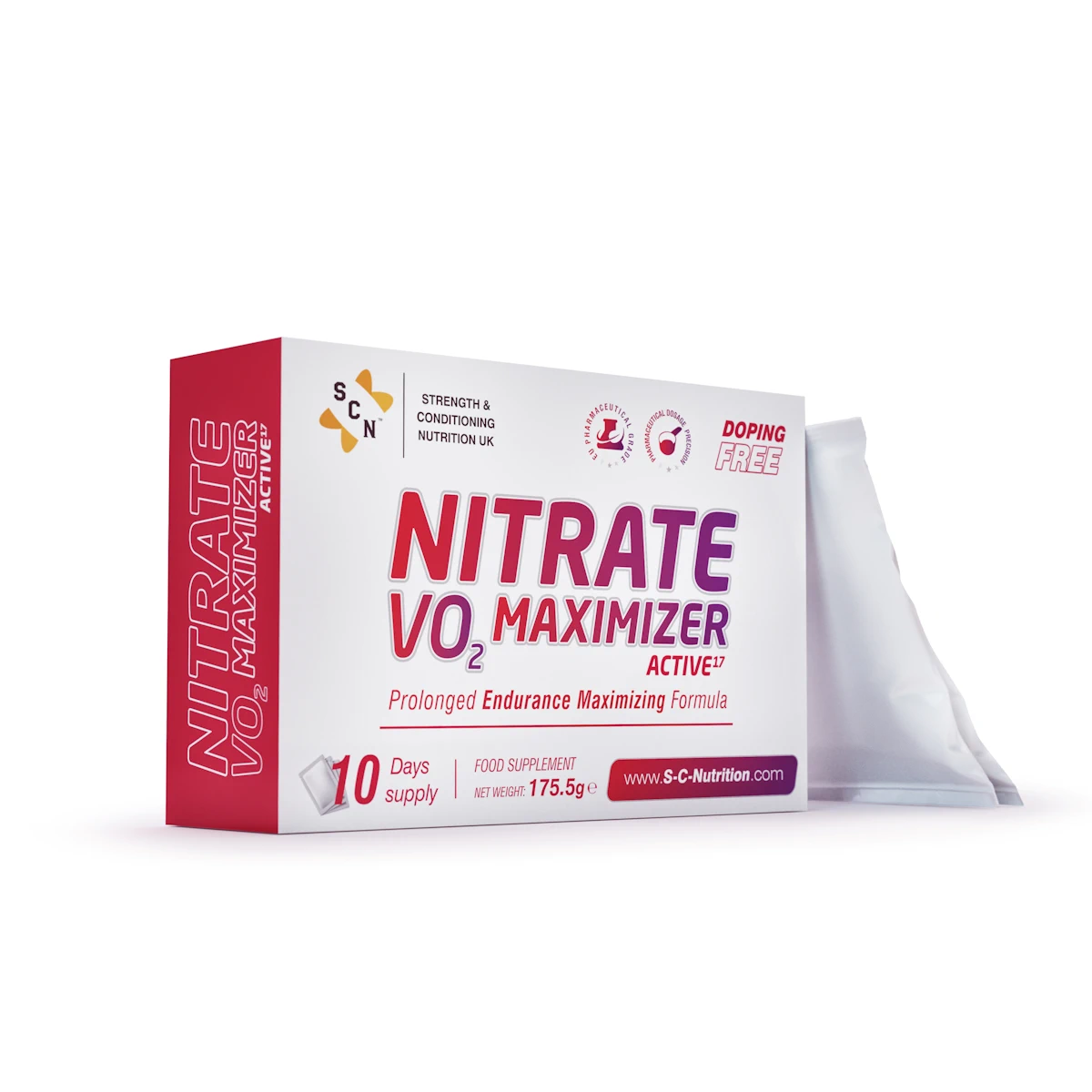
Nitrate VO2 Maximizer¹⁷
The 60:1 beetroot formula with the nitrate number printed on the label — 750 mg total nitrate per sachet, inside a 17-ingredient endurance formula.
View the formulaThe question the industry does not want you to ask
Here is the critical insight, and you should use it against every product you consider buying — including ours.
An extract ratio is not a nitrate number.
60:1 tells you about the concentration process. It does not, by itself, tell you how many milligrams of nitrate you are swallowing. Two different 60:1 beetroot extracts can differ meaningfully in nitrate content depending on the source material and the extraction method used.
So the ratio is necessary but not sufficient. The number that actually predicts whether you will feel anything is total nitrate per serving, stated in milligrams.
Almost no brand prints that number. Ask yourself why.
What Nitrate VO2 Maximizer¹⁷ actually delivers
Our formula provides 750 mg of total nitrate per sachet.
That figure comes from a deliberate dual-source design:
1000 mg of 60:1 beetroot extract, delivering the full natural nitrate profile alongside beetroot's own betalain antioxidants — the compounds a synthetic nitrate salt cannot give you.
1500 mg of arginine nitrate, which supplies nitrate directly while simultaneously feeding the separate L-arginine pathway to nitric oxide.
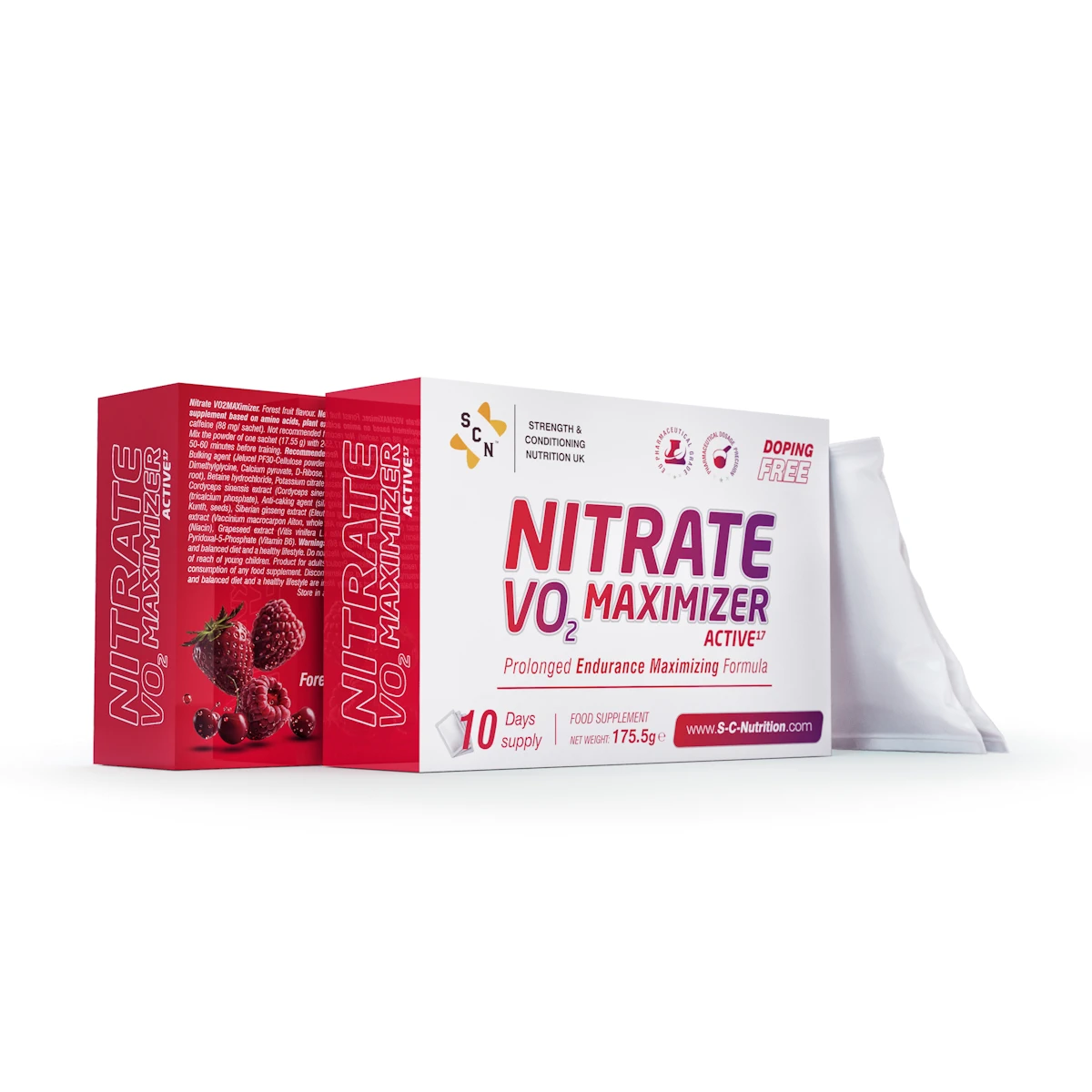
That combination matters more than it might sound. Your body makes nitric oxide through two distinct routes. The nitrate–nitrite pathway works especially well when oxygen is scarce and the muscle is acidic — exactly the conditions of hard endurance work. The arginine–nitric oxide synthase pathway is more active in well-oxygenated tissue. Most products feed one or the other. This formula feeds both simultaneously, from a single serving, in powder form, with no refrigeration and no sugar load.
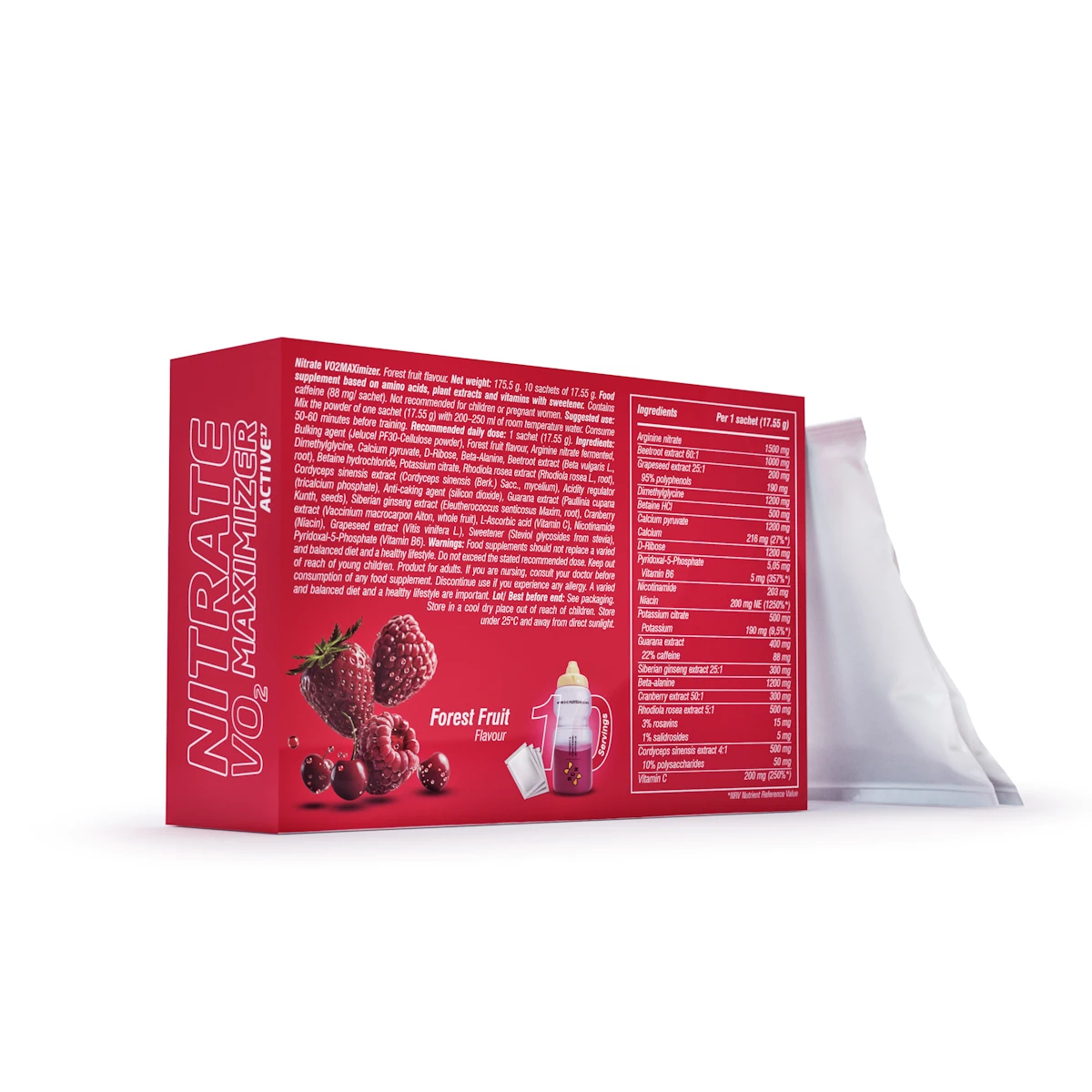
750 mg of nitrate. Two pathways. One sachet.
Mix with 200–250 ml of water, 50–60 minutes before training. 10 sachets per box, forest fruits flavour.
Order Nitrate VO2 Maximizer¹⁷Doping-free and cross-contamination safe. Formulated and manufactured to S-C Nutrition specification.
The eight sport benefits of concentrated beetroot nitrate
- Reduced oxygen cost of exercise. Elevated plasma nitrate lowers the amount of oxygen required to sustain a given workload — the mechanism that effectively raises your usable aerobic ceiling.
- Improved mitochondrial efficiency. Nitric oxide improves the coupling of your mitochondria, so more of the fuel you burn becomes movement rather than heat.
- Enhanced muscle contractile efficiency. Nitrate improves calcium handling within the muscle fibre, meaning each contraction costs less energy.
- Preferential blood flow to Type II fibres. Nitrate-derived nitric oxide directs blood specifically toward the fast-twitch fibres that fatigue first — which is why it helps with surges, climbs and finishing kicks, not just steady pace.
- Increased time to exhaustion. Across the endurance literature this is the most consistently reported outcome: athletes last longer at the same intensity.
- Improved peak power output. The Type II fibre effect translates into measurably better sprint and explosive performance late in an event.
- Faster recovery through reduced oxidative stress. Beetroot's betalain pigments are potent antioxidants, blunting some of the cellular damage of hard training.
- Enhanced neuromuscular performance. Better blood flow to working tissue supports the speed and quality of muscle recruitment under fatigue.
The eight health benefits beyond sport
- Healthy blood pressure support. Dietary nitrate has one of the best-studied effects of any natural compound on both systolic and diastolic readings.
- Endothelial support. Nitric oxide is the primary signal that keeps the lining of your blood vessels flexible and responsive — the foundation of long-term vascular health.
- Improved cerebral blood flow. Nitrate increases perfusion of the frontal lobe specifically, the region governing executive function and decision-making.
- Cognitive support with age. That frontal-lobe effect is one reason nitrate has drawn serious attention in healthy-ageing research, where declining nitric oxide production is a known feature.
- Antioxidant protection from betalains. These pigments are relatively rare in the food supply and act against oxidative stress throughout the body.
- Healthy inflammatory response. Beetroot compounds support the body's normal regulation of inflammation.
- Liver and detoxification support. Betaine, naturally present in beetroot, plays a direct role in liver fat metabolism.
- Metabolic and circulatory health. Improved blood flow supports glucose delivery and overall metabolic function.
Why the synergy matters more than any single ingredient
A nitrate product that contains only nitrate is solving one quarter of the problem. Nitrate improves how efficiently you use oxygen — but it does nothing about acid accumulation, nothing about ATP depletion, and nothing about the stress load of hard training. Those are the other three walls you hit.
So the formula is built around beetroot rather than in spite of it.
For acid buffering
1200 mg beta-alanine raises muscle carnosine to soak up the hydrogen ions that cause the burn, and 1200 mg dimethylglycine (DMG) supports oxygen use at the cellular level. Nitrate improves oxygen delivery; these two make sure the muscle can keep working once it arrives.
For energy resynthesis
1200 mg D-ribose provides the structural backbone of the ATP molecule, and calcium pyruvate feeds the Krebs cycle directly. Blood flow is useless if there is no fuel waiting at the destination.
For vascular protection
Grapeseed extract at 95% polyphenols protects the blood vessels that nitric oxide is working to dilate, and vitamin C supports nitric oxide's stability once produced. This is genuine two-way synergy: the antioxidants extend the life of the nitric oxide you just generated.
For stress resilience
The adaptogen trio — rhodiola (5:1), cordyceps (4:1) and Siberian ginseng (25:1) — supports the body's response to training load. Cordyceps in particular has its own literature on oxygen utilisation, working alongside the nitrate rather than duplicating it.
For delivery and conversion
HCl βηταΐνης supports absorption, while pyridoxal-5-phosphate and high-dose nicotinamide drive the enzymatic machinery that turns all of it into usable energy.
Seventeen ingredients, one physiological target: getting more oxygen to the muscle, using it more efficiently, and clearing the waste faster.
Built around the beetroot — not instead of it
60:1 beetroot extract, arginine nitrate, beta-alanine, DMG, D-ribose, three adaptogens and the cofactors that make them work. 750 mg total nitrate per sachet.
See the full 17-ingredient formulaWhat to do with this information
Next time you look at a beetroot product, ask three questions:
What form is the beetroot in? Powder, juice, concentrate or extract — they are not interchangeable.
If it is an extract, what is the ratio? No ratio on the label means no concentration worth declaring.
How many milligrams of nitrate does one serving contain? This is the question that ends most conversations.
Most labels will fail at the first question. Almost all will fail at the third.
Ours answers all three: a 60:1 ultra-concentrated extract, paired with arginine nitrate, delivering 750 mg of total nitrate per sachet, inside a 17-ingredient formula built specifically for endurance athletes.
Stop guessing what is in your beetroot
Nitrate VO2 Maximizer¹⁷ — instant VO2 maximizing formula. 10 sachets, forest fruits.
Buy nowThis article is for education and general information only. Food supplements should not replace a varied and balanced diet or a healthy lifestyle. Do not exceed the stated recommended dose. Consult a physician if you are pregnant or lactating. Discontinue use if you experience any allergy.