Περιγραφή
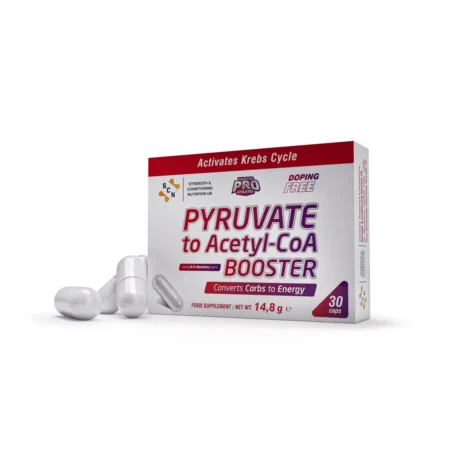
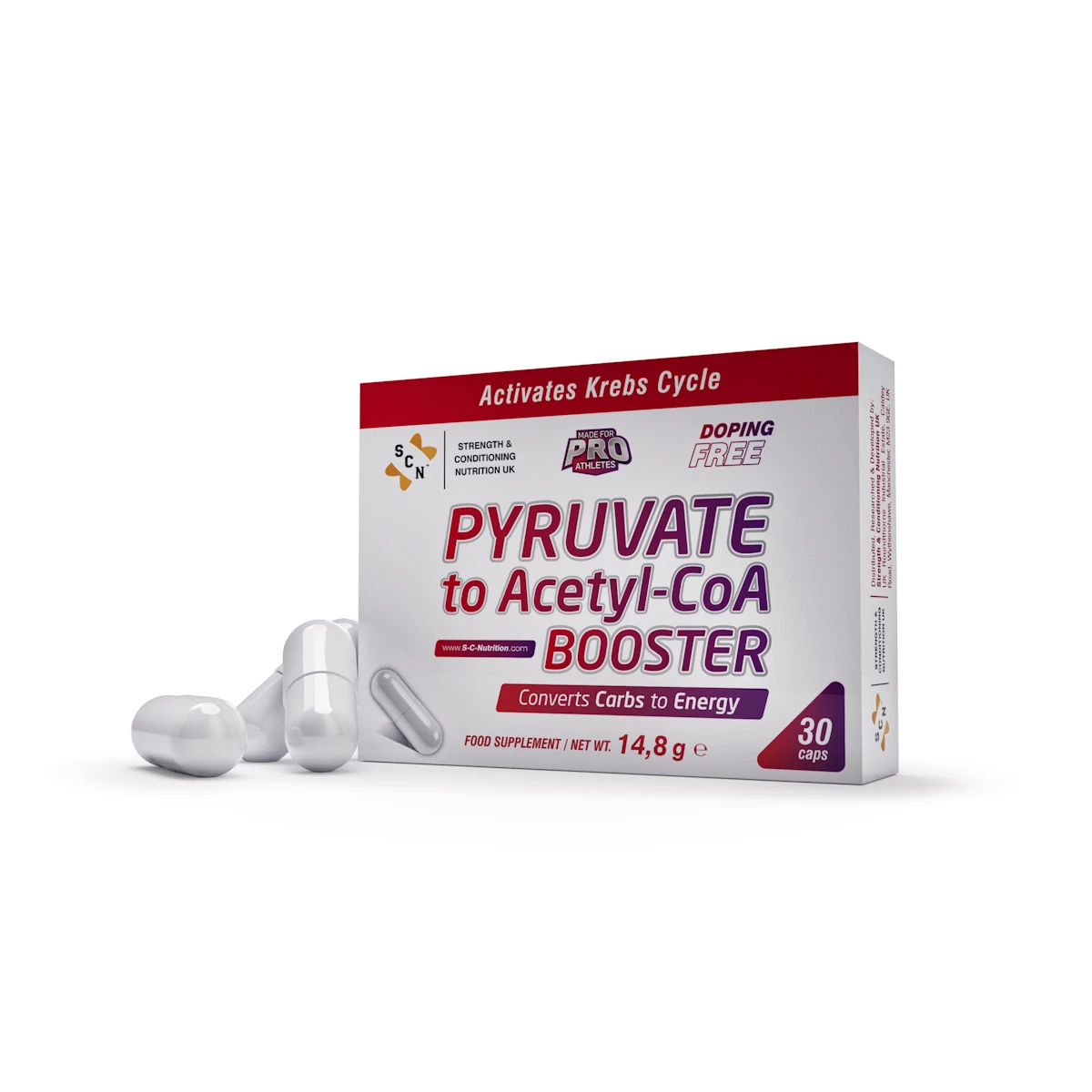
Pyruvate to Acetyl-CoA Booster
The Active Vitamin B1 for Energy — Thiamine Pyrophosphate (TPP)
Most vitamin B1 for energy supplements give you thiamine HCl and leave the hard work to your liver. SCN™ gives you thiamine pyrophosphate — the coenzyme form your mitochondria actually use — so the bridge from carbohydrate to ATP is open from the first capsule.
Coenzymated B1 — no conversion needed
Energy-yielding metabolism*
Nervous system & heart function*
Doping-free · Made in the EU
Turn pyruvate into power, not lactate
Thiamine pyrophosphate is the cofactor that lets pyruvate dehydrogenase feed carbohydrate into the Krebs cycle. More aerobic flux, less pyruvate spilling into lactate. Take 1–2 capsules an hour before long or hard sessions.
Vitamin B1 for energy and mental clarity
The brain burns around 20% of your glucose and relies on TPP to do it. Thiamine contributes to normal psychological function and normal nervous-system function — the active form gets there without a metabolic detour.
Keep the mitochondrial gateway open
Thiamine phosphorylation can become less efficient with age, medication load and digestive stress. Supplying the finished coenzyme bypasses the bottleneck and supports normal energy-yielding metabolism and heart function.
Θρεπτικά συστατικά ανά συνιστώμενη ημερήσια δόση
| Active ingredient | 1 capsule | 2 κάψουλες |
|---|---|---|
| Thiamine pyrophosphate chloride (cocarboxylase) | 20 mg | 40 mg |
| of which vitamin B1 (thiamine) | 13 mg (1882 % NRV*) | 26 mg (3764 % NRV*) |
*NRV = Nutrient Reference Value. Vitamin B1 contributes to normal energy-yielding metabolism, normal functioning of the nervous system, normal psychological function and normal function of the heart (EU authorised health claims).
Full ingredients: Bulking agent (microcrystalline cellulose), capsule shell (glazing agent: hydroxypropyl methylcellulose; colour: calcium carbonate), thiamine pyrophosphate chloride (vitamin B1), anti-caking agents (magnesium salts of fatty acids, silicon dioxide).
Πληροφορίες για το προϊόν: 30 vegetarian capsules × 20 mg TPP (2 blisters of 15). Doping-free, cross-contamination safe, manufactured in the EU.
What is thiamine pyrophosphate — and why does the form of your vitamin B1 matter?
Thiamine pyrophosphate (TPP), also called cocarboxylase or thiamine diphosphate, is the biologically active coenzyme form of vitamin B1. Every other B1 you can buy — thiamine hydrochloride, thiamine mononitrate, even the fat-soluble benfotiamine — is a precursor. Before it can do anything, your body has to absorb it, transport it into the cell and phosphorylate it twice via the enzyme thiamine pyrophosphokinase. Only then does it become TPP.
TPP is the molecule at the end of that chain. It sits in the active site of the pyruvate dehydrogenase (PDH) complex, the gateway enzyme that converts pyruvate — the end product of glycolysis — into acetyl-CoA, the fuel of the Krebs cycle. Without TPP the bridge between the carbohydrate you eat and the ATP you feel cannot be crossed.
Why TPP is superior to other vitamin B1 forms
- No conversion required. Standard B1 must be phosphorylated before it works. Genetic variation in thiamine transporters and kinases, digestive issues, alcohol, heavy training loads and some medications all reduce the efficiency of that step. TPP skips it.
- Immediate coenzyme availability. Because it is already in the coenzyme state, TPP is ready for the mitochondrial PDH complex and the α-ketoglutarate dehydrogenase complex — two of the rate-controlling steps of aerobic energy production.
- Transketolase support. TPP is also the cofactor for transketolase in the pentose phosphate pathway, which produces NADPH (your antioxidant currency) and ribose for nucleotide and ATP synthesis.
- Brain-relevant. Acetyl-CoA produced via TPP is the substrate for acetylcholine synthesis, the neurotransmitter of memory, attention and muscle contraction — which is why vitamin B1 contributes to normal psychological and nervous-system function.
- Clinically dosed. 20 mg of true TPP per capsule, not a trace amount hidden inside a B-complex.
Health benefits of thiamine pyrophosphate
- Normal energy-yielding metabolism. TPP is the cofactor that lets glucose be oxidised fully in the mitochondria instead of ending as pyruvate and lactate.
- Normal functioning of the nervous system. Nerve tissue runs almost exclusively on glucose oxidation and is therefore among the most TPP-dependent tissues in the body.
- Normal psychological function. Adequate thiamine status supports attention, mood and mental energy; the coenzyme form provides the most direct route.
- Normal function of the heart. Cardiac muscle has one of the highest ATP turnovers of any organ; constant acetyl-CoA supply is what keeps the rhythm efficient.
- Carbohydrate handling. By accelerating pyruvate oxidation, TPP helps the body use the carbohydrates you eat as fuel rather than leaving them as metabolic traffic.
Sport benefits of thiamine pyrophosphate for endurance athletes
- Less pyruvate diverted to lactate. When PDH can’t keep up, pyruvate is reduced to lactate. TPP raises PDH capacity, helping delay the burn and the hydrogen-ion accumulation that comes with it.
- Higher aerobic efficiency. In athletes performing aerobic exercise, TPP supplementation lowered serum lactate and improved VO₂max and heart-rate efficiency in a controlled study (see Science below).
- Faster recovery between sessions. A Krebs cycle running without a TPP bottleneck replenishes energy stores more efficiently after long or glycogen-depleting training.
- Higher carbohydrate demand = higher thiamine demand. Endurance athletes eating 6–10 g carbohydrate per kg per day need proportionally more B1 to process it. A carb-fuelled athlete on thiamine HCl alone is leaving performance on the table.
- Mental focus under fatigue. Acetylcholine-dependent attention and coordination hold up better when neural energy supply holds up — the difference between clean technique and sloppy form in the last hour.
How does it work on energy production?
Think of your metabolism as a high-performance engine. Glucose is the fuel, but fuel must be refined before it can be burned.
The gateway molecule
Carbohydrate is broken down to pyruvate in the cytoplasm. To enter the mitochondria it must be converted into acetyl-CoA.
The decarboxylation spark
TPP is the coenzyme of pyruvate dehydrogenase. It binds pyruvate, removes one carbon as CO₂ and forms the two-carbon hydroxyethyl unit needed for energy.
The ATP payoff
Acetyl-CoA enters the Krebs cycle and the electron transport chain, where the overwhelming majority of your ATP is generated.
In short: without enough TPP the bridge to aerobic energy is washed out. Supplying the pyrophosphate form keeps that metabolic bridge open and working.
Chemistry explained: the “chemical hook” of TPP
The power of TPP lies in its thiazolium ring. The carbon between the nitrogen and sulfur atoms (C‑2) is unusually acidic. It loses a proton to form a carbanion, and that negatively charged carbon attacks the carbonyl carbon of pyruvate. The pyruvate is now tethered to the enzyme, so the volatile intermediate cannot float away before the reaction is complete.
The PDH complex, step by step
- Decarboxylation (the TPP step, enzyme E1). TPP binds pyruvate, CO₂ is released, and the remaining two-carbon hydroxyethyl-TPP stays covalently bound.
- Transfer to lipoamide (E2). The hydroxyethyl group is oxidised to an acetyl group and handed to lipoic acid, freeing TPP to grab the next pyruvate.
- Formation of acetyl-CoA. The acetyl group is transferred to coenzyme A, creating acetyl-CoA, ready for the Krebs cycle.
The cofactor team that finishes the job
TPP starts the reaction, but the PDH complex works like an assembly line with four more essential players — which is why SCN™ designs its energy products to be stacked.
- Lipoic acid (lipoamide) — the “robotic arm” on E2 that carries the acetyl group to coenzyme A; also a regenerating antioxidant.
- Coenzyme A — made from vitamin B5 (pantothenic acid); the shipping container that forms acetyl-CoA.
- FAD — from vitamin B2 (riboflavin); resets the reduced lipoamide arm so it can work again, becoming FADH₂.
- NAD⁺ — from vitamin B3 (niacin); the final electron carrier that becomes NADH and delivers electrons to the electron transport chain for bulk ATP production.
The science behind vitamin B1 for energy and performance
- TPP in athletes — lactate, VO₂max and heart rate. In a controlled trial, athletes who received thiamine pyrophosphate before aerobic activity showed lower serum lactate, higher maximum oxygen consumption and a lower heart rate at a given workload than controls. Bautista‑Hernández VM et al., J Int Med Res 2008;36(6):1220‑6.
- Thiamine and exercise-induced fatigue. Thiamine supplementation reduced blood lactate and glucose accumulation and lowered subjective fatigue after exercise in healthy subjects. Choi SK et al., Metab Brain Dis 2013;28(2):261‑5. An earlier study reached the same conclusion: Suzuki M & Itokawa Y, Metab Brain Dis 1996;11(1):95‑106.
- Why the coenzyme form matters. A comprehensive review of thiamine biochemistry describes the dependence of pyruvate dehydrogenase, α‑ketoglutarate dehydrogenase and transketolase on TPP and the limits of relying on conversion from thiamine precursors. Lonsdale D, Evid Based Complement Alternat Med 2006;3(1):49‑59.
- Thiamine function, uptake and transport. Reviews the two-step phosphorylation of thiamine to TPP and the transporters and kinases that limit it. Manzetti S et al., Biochemistry 2014;53(5):821‑35.
- Authorised EU health claims. The European Food Safety Authority confirmed cause-and-effect relationships between thiamine and energy-yielding metabolism, nervous-system function, psychological function and heart function. EFSA Journal 2009;7(9):1222 and 2010;8(10):1755.
Προτεινόμενη χρήση
| Goal | Dose | Timing |
|---|---|---|
| Demanding lifestyle, brain & wellbeing | 1 capsule | In the morning with water |
| Energy production for sport | 1–2 capsules | About 1 hour before training or racing |
| Heavy carbohydrate-loading blocks | 2 κάψουλες | Morning, on high-carb days |
Recommended daily dose: 1–2 capsules. Do not exceed the recommended dose. Food supplements should not be used as a substitute for a varied, balanced diet and a healthy lifestyle. Keep out of reach of children. Store in a cool, dry place.
Frequently asked questions
Is thiamine pyrophosphate the same as vitamin B1?
It is the active coenzyme form of vitamin B1. Thiamine HCl and mononitrate are precursors your body must phosphorylate twice to make TPP; this product supplies TPP directly.
Why is the NRV so high?
The NRV for vitamin B1 is only 1.1 mg — a maintenance level. Athletes processing large carbohydrate loads, and anyone whose thiamine conversion is inefficient, benefit from the higher physiological doses used in the studies above. Thiamine is water-soluble and excess is excreted.
Is it better than benfotiamine?
Benfotiamine is a fat-soluble precursor that still has to be converted to TPP inside the cell. TPP is the end molecule. For mitochondrial energy production we consider the finished coenzyme the most direct choice.
Can I take it with other SCN™ products?
Yes. It stacks naturally with NADH, Mitochondrial Activator¹⁴, Endurance Carbs and Pre-Endurance Training Activator.
Is it doping-free?
Yes. Like every SCN™ product it is manufactured in the EU under a doping-free, cross-contamination-safe protocol.

This website is for your education and general health information only. The ideas, opinions and suggestions contained on this website are not to be used as a substitute for medical advice, diagnosis or treatment from your doctor for any health condition or problem. Please do not start or stop any medications without consulting with your doctor.