Descripción
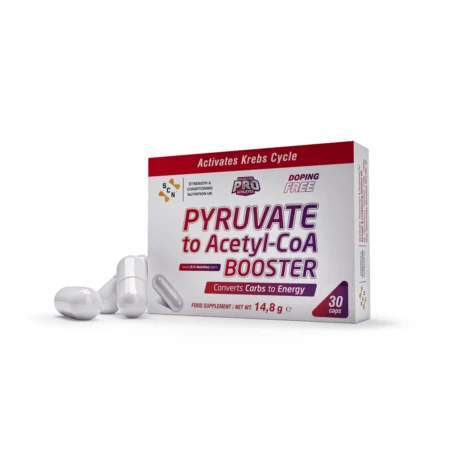
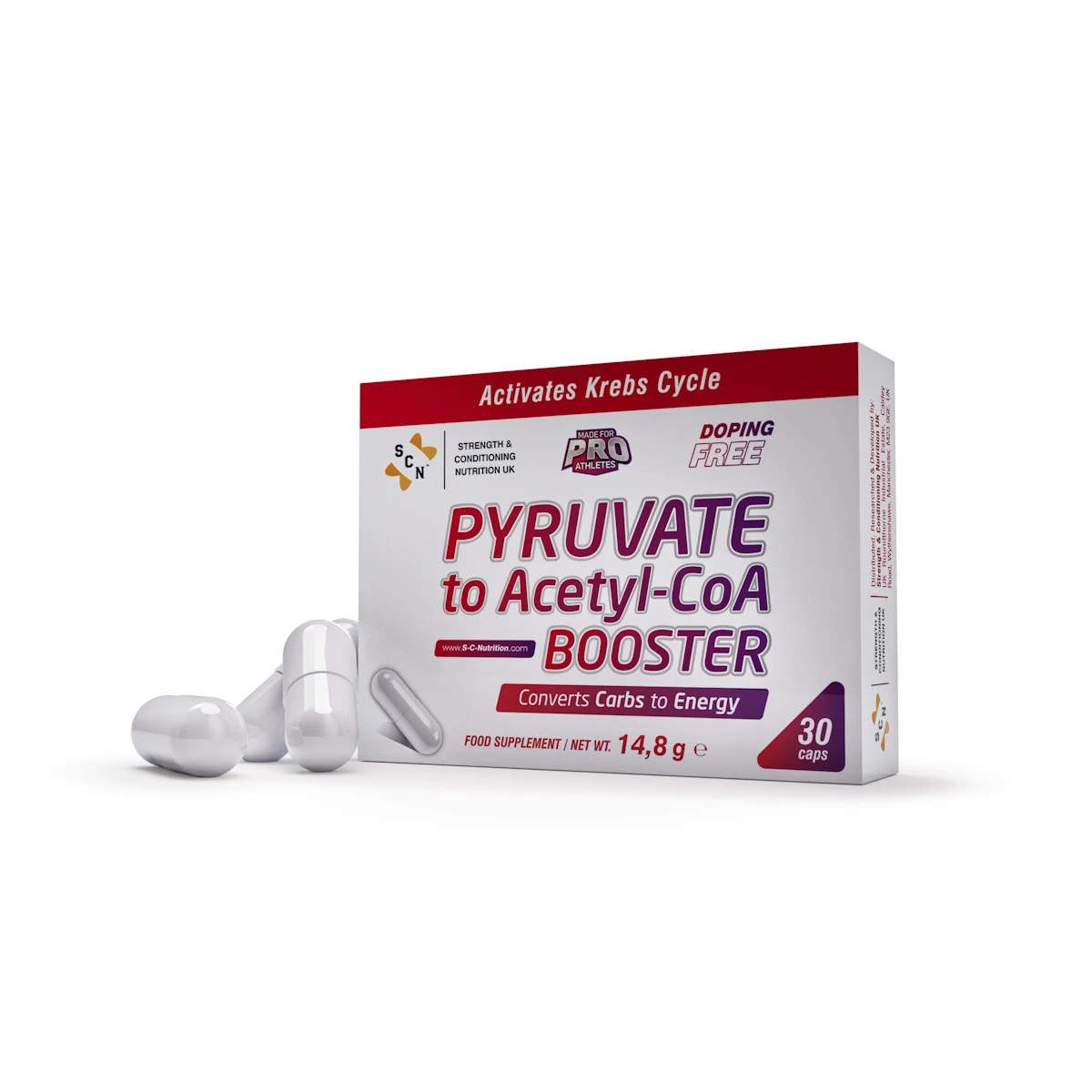
Pyruvate to Acetyl-CoA Booster
The absolutely Powerful Co-Enzymated Vitamin B1 to start producing energy
Pyruvate to Acetyl-CoA Booster, is based on Thiamine Pyrophosphate, a super powerful form of B1 vitamin.
Nutrientes por dosis diaria recomendada:
| Ingrediente | 1 capsule / 2 capsules |
| Thiamine Pyrophosphate
Vitamina B1 |
20 mg / 40mg
13 mg (1882 %*) / 26mg (3764%*) |
*VNR Valor de referencia de nutrientes
What is Thiamine Pyrophosphate (TPP) and Why Does It Matter?
Most supplements use standard Thiamine HCl, which your body has to work hard to convert. Thiamine Pyrophosphate is the metabolically active coenzyme form. By skipping the conversion process, your body gets immediate access to the “spark plug” of cellular energy.
Thiamine Pyrophosphate (TPP), also known as Cocarboxylase, is the biologically active “coenzyme” form of Vitamin B1. Unlike standard vitamins that require your liver to process them, TPP is the exact molecule your body uses to spark life-sustaining chemical reactions.
In the world of biochemistry, TPP acts as a metabolic key. It sits at the center of the Pyruvate Dehydrogenase complex, where it performs the heavy lifting of converting food into cellular energy (ATP). Without TPP, the bridge between the food you eat and the energy you feel simply cannot be crossed.
Why is TPP Superior to Other Vitamin B1 Forms?
When you see “Thiamine Hydrochloride” or “Thiamine Mononitrate” on a label, you are looking at synthetic precursors. Here is why choosing Thiamine Pyrophosphate is a superior investment for your health:
- No Conversion Required: Standard B1 must be phosphorylated by the enzyme thiamine pyrophosphokinase before it can work. Many individuals have genetic variations or digestive issues that make this conversion inefficient. TPP bypasses this bottleneck entirely.
- Immediate Bioavailability: Because it is already in its coenzyme state, TPP is ready to be utilized by your mitochondria the moment it enters your system.
- Enhanced Brain Support: TPP is a critical factor in the synthesis of acetylcholine, the “memory neurotransmitter.” By providing the active form, you provide more direct support for cognitive clarity and nerve function.
Maximum Energy Production at the Cellular Level
TPP is the primary driver of the Pyruvate Dehydrogenase complex. This is the critical gateway that converts pyruvate into Acetyl-CoA, the fuel required for the Citric Acid Cycle. Without adequate TPP, your “engine” stalls, leading to fatigue and a buildup of lactic acid.
Support for Brain Health and Cognitive Clarity
The brain is an energy hog, consuming roughly 20% of your body’s total glucose. Because TPP is essential for glucose metabolism, supplementing with the active form supports neurotransmitter synthesis and helps clear the “brain fog” often associated with B-vitamin deficiencies.
Glucose Metabolism: The Engine of Cellular Energy
The most vital role of TPP is its ability to unlock energy from carbohydrates. Through a process called decarboxylation, TPP helps transform pyruvate into Acetyl-CoA.
This transition is the “Point of No Return” in energy production. By facilitating this conversion, TPP ensures that glucose is burned cleanly and efficiently for fuel, rather than being diverted into lactic acid. For athletes, professionals, and those managing metabolic health, TPP is the essential tool for maintaining steady, crash-free energy levels throughout the day.
Which are the Health Benefits of Thiamine Pyrophosphate?
Supplying your body with the active coenzyme form of Vitamin B1 provides systemic support that standard thiamine simply can’t match. Because TPP is “system-ready,” it offers several key health advantages:
- Optimal Neurological Function: TPP is essential for the synthesis of acetilcolina, the primary neurotransmitter responsible for memory, focus, and muscle control.
- Cardiovascular Support: The heart is one of the most energy-demanding organs in the body. TPP helps maintain heart muscle tone and efficient rhythmic function by ensuring constant ATP availability.
- Blood Sugar Management: By acting as a critical cofactor in glucose oxidation, TPP helps the body process carbohydrates more effectively, supporting healthy blood sugar balance.
- Nervous System Protection: It helps maintain the myelin sheath—the protective coating around nerves—reducing the risk of tingling or discomfort associated with B1 deficiencies.
Which are the Sport Benefits of Thiamine Pyrophosphate?
For athletes and high-performers, Thiamine Pyrophosphate is the “hidden” key to endurance and recovery. If you are pushing your physical limits, TPP provides a distinct edge:
- Lactic Acid Reduction: When your body can’t convert pyruvate to Acetyl-CoA fast enough, it turns into lactic acid. TPP accelerates this conversion, helping to delay the “burn” and reduce post-workout soreness.
- Enhanced VO2 Max Efficiency: By streamlining the oxygen-dependent energy pathways in your mitochondria, TPP allows for more efficient aerobic energy production during high-intensity training.
- Rapid Recovery: By ensuring the Citric Acid Cycle (Krebs Cycle) runs without bottlenecks, TPP helps your body replenish energy stores faster after grueling sessions.
- Mental Focus Under Pressure: TPP supports the “calm energy” needed for technical sports, preventing the mental fatigue that leads to poor form and injury.
How Does it Work on Energy Production?
To understand how TPP works, think of your metabolism as a high-performance engine. Food (glucose) is the fuel, but that fuel must be refined before it can be burned.
- The Gateway Molecule: After you eat, your body breaks carbs down into Pyruvate. To enter the mitochondria (the cell’s power plant), pyruvate must be converted into Acetyl-CoA.
- The Decarboxylation Spark: TPP is the primary coenzyme for the Pyruvate Dehydrogenase (PDH) complex. It literally “grabs” the pyruvate and strips away a carbon atom (releasing CO2), transforming it into the two-carbon unit needed for energy.
- The ATP Payoff: Once TPP facilitates the creation of Acetyl-CoA, it enters the Krebs Cycle. This is where the bulk of your ATP (Adenosine Triphosphate) is generated.
In short: Without enough TPP, the bridge to energy production is washed out. By supplementing with the pyrophosphate form, you ensure that this “metabolic bridge” is always open and operating at 100% capacity.
Chemistry Explained:
Thiamine pyrophosphate (TPP) is the active form of Vitamina B1 (thiamine) and serves as a vital coenzyme in energy metabolism. Its most famous “day job” is helping the Pyruvate Dehydrogenase (PDH) Complex bridge the gap between glycolysis and the Citric Acid Cycle.
Without TPP, your cells would struggle to turn sugar into usable energy, leading to a massive backup of lactic acid.
How TPP Functions: The “Chemical Hook”
The secret to TPP’s power lies in its thiazolium ring. Specifically, the carbon atom between the nitrogen and sulfur (the C-2 position) is highly acidic.
- Ionization: The C-2 atom loses a proton to become a carbanion (a carbon with a negative charge).
- Nucleophilic Attack: This negatively charged carbon is “hungry” for positive centers. It attacks the carbonyl carbon of pyruvate.
The PDH Complex: Converting Pyruvate to Acetyl-CoA
The conversion of pyruvate to Acetyl-CoA is a multi-step process involving three enzymes. TPP is the prosthetic group for the first enzyme, Pyruvate Dehydrogenase .
1.Decarboxylation (The TPP Step)
Pyruvate is a three-carbon molecule. To turn it into the two-carbon Acetyl-CoA, we have to remove a molecule of CO2.
- TPP binds to pyruvate.
- The CO2 is released.
- What remains is a two-carbon “hydroxyethyl” group, which stays covalently bonded to TPP. This intermediate is called hydroxyethyl-TPP.
2.Transfer to Lipoamide
The hydroxyethyl group doesn’t stay on TPP for long. It is oxidized and transferred to the next coenzyme, lipoamide, on the E2 enzyme. This “handoff” frees up the TPP to go grab another pyruvate molecule.
3.Formation of Acetyl-CoA
Finally, the acetyl group is transferred to Coenzyme A, creating Acetyl-CoA, which is now ready to enter the Krebs Cycle to generate ATP.
Summary of the Reaction
The overall transformation facilitated by TPP and the PDH complex can be summarized by this equation:
Pyruvate + CoA-SH + NAD+ → Acetyl-CoA + CO2 + NADH + H+
Why this matters
- Neurology: The brain relies almost exclusively on glucose oxidation. Because TPP is essential for this, B1 deficiency (Beriberi or Wernicke-Korsakoff syndrome) hits the nervous system first.
- Efficiency: TPP allows the cell to “tether” the pyruvate, ensuring the volatile intermediate doesn’t float away before the reaction is finished.
Other cofactors involved in this process (FAD & Lipoic Acid)
To turn pyruvate into Acetyl-CoA, the Pyruvate Dehydrogenase (PDH) Complex operates like a high-tech assembly line. While TPP starts the reaction, it requires a “team” of four other cofactors to finish the job.
Here is the breakdown of the other essential players and how they complete the energy production circuit.
1. Lipoic Acid (Lipoamide)
If TPP is the “spark,” Lipoic Acid is the “robotic arm.” It is covalently bound to the E2 enzyme.
- The Job: Once TPP has decarboxylated the pyruvate, Lipoic Acid swings over to grab the remaining two-carbon acetyl group.
- The Transformation: It oxidizes the acetyl group and carries it toward the Coenzyme A.
- Key Benefit: It is a powerful antioxidant that can regenerate other vitamins like C and E.
2. Coenzyme A (CoA-SH)
Derived from Vitamin B5 (Pantothenic Acid), Coenzyme A is the final “shipping container” for the acetyl group.
- The Job: It accepts the acetyl group from the Lipoic Acid arm.
- The Result: This forms Acetyl-CoA, the high-energy molecule that officially enters the Krebs Cycle (Citric Acid Cycle) to produce ATP.
3. FAD (Flavin Adenine Dinucleotide)
Derived from Vitamin B2 (Riboflavin), FAD acts as a temporary electronic storage battery.
- The Job: After the acetyl group is handed off to CoA, the Lipoic Acid “arm” is left in a reduced state (it’s “full” of electrons and can’t work anymore). FAD steps in to take those electrons away, resetting the Lipoic Acid so it can grab the next pyruvate.
- The Result: FAD becomes FADH2
4. NAD+ (Nicotinamide Adenine Dinucleotide)
Derived from Vitamin B3 (Niacin), NAD+ is the final electron carrier.
- The Job: It takes the electrons from FADH2
- The Payoff: It becomes NADH. This NADH then travels to the Electron Transport Chain (the “power grid” of the cell) to generate a massive amount of ATP.
Información sobre el producto: 30 capsules of 20mg TPP (2 x 15 caps blisters)
Uso recomendado:
Demanding Lifestyle: Consume 1 capsule in the morning.
Energy Production for Sports: Consume 1-2 capsules 1 hour before training. Recommended daily dose: 1-2
cápsulas.
Ingredientes: Bulking agent (Microcrystalline cellulose), Capsule (Glazing agent (Hydroxypropyl methylcellulose), Colour (Calcium carbonate)), Thiamine pyrophosphate chloride (Vitamin B1), Anti-caking agents (Magnesium salts of fatty acids, silicon dioxide).

*Este sitio web es sólo para su educación e información general sobre la salud. Las ideas, opiniones y sugerencias contenidas en este sitio web no deben utilizarse como sustituto del consejo médico, diagnóstico o tratamiento de su médico para cualquier condición o problema de salud. Los usuarios de este sitio web no deben basarse en la información facilitada en él para tratar sus propios problemas de salud. Cualquier pregunta relacionada con su propia salud debe dirigirse a su propio médico. No empiece ni deje de tomar ningún medicamento sin consultar a su médico. No le animamos a que lo haga, ni nos hacemos responsables de las consecuencias de no consultar a un médico.